

In the world of B2B marketing, traffic is a promise, but conversion is the proof. You can have the most brilliant content strategy, the most effective SEO, and a steady stream of qualified visitors arriving at your digital doorstep. But if those visitors browse, linger, and then vanish without a trace, your marketing engine is ultimately failing. This is the harsh reality for countless businesses: their website is a beautiful, informative, and expensive digital brochure that is tragically ineffective at its single most important job—generating leads.
This is the story of how we helped one such business, a promising B2B SaaS company, fundamentally solve this problem. It is a transparent, step-by-step breakdown of how we moved beyond traditional marketing tactics and implemented a single, powerful technology—an intelligent AI agent—to increase their qualified demo request conversion rate by over 50% in just six months.
For confidentiality, we will call our client “FinPro Solutions.” They had all the ingredients for success: a brilliant financial planning software for small businesses, a professional and well-designed website, and a steady stream of organic traffic thanks to a solid content marketing program. But they had a critical leak in their sales funnel. Their visitor-to-demo conversion rate was stuck at a dismal 0.5%. Their highly skilled, expensive human sales team was spending the majority of their day sifting through low-quality inquiries from a generic “Contact Us” form, a process that was both inefficient and soul-crushing.
As a media and marketing strategist with two decades of experience, I know that this is one of the most common and frustrating challenges businesses face. This case study is not a theoretical discussion about the future. It is a practical, real-world playbook that details the exact diagnosis, strategy, and execution we used to turn FinPro’s passive website into an active, intelligent, and highly effective lead generation machine.
The diagnosis: why a good website with good traffic was failing to convert
Before prescribing a solution, a deep and accurate diagnosis is essential. The first step was to understand why FinPro’s seemingly healthy website was underperforming so dramatically. We conducted a deep dive into their user journey, combining quantitative data from their analytics with the qualitative insights from AI-powered user behavior analysis tools.
A deep dive into the user journey and points of friction
We used tools that allowed us to analyze thousands of anonymized visitor session recordings and heatmaps. This was like placing a ghost in the machine, allowing us to see the website through the eyes of a real user. The AI in these platforms automatically flagged patterns of user frustration and hesitation. Several critical problems quickly became apparent:
- The “paradox of choice” on the features and pricing pages: FinPro’s software was powerful and had a rich feature set. However, the website presented these features in long, overwhelming lists. We observed countless session recordings where users would scroll frantically up and down the pricing page, trying to compare the three different tiers, clearly confused about which plan was right for them. This decision paralysis was a major exit point.
- The “black hole” of the contact form: The primary call-to-action on the site was a generic “Contact Us” button that led to a simple form. For a user with a specific pre-sales question, this felt like a dead end. They had no idea who would receive their message or when they might get a response. It was a high-friction, low-confidence conversion point.
- The 24/7 problem and the missed opportunity: Analytics revealed that a significant portion of their ideal traffic—small business owners and finance managers—were browsing the site outside of standard US business hours (early in the morning, late at night, and on weekends). During these times, the website was a silent, unstaffed digital showroom. These highly motivated visitors had questions, but with no one available to answer them, they simply left.
Analyzing the deep inefficiencies of the old lead qualification process
The problems continued even when a lead did come through. Every form submission, regardless of its quality, landed in a single, shared sales inbox. A human Sales Development Representative (SDR) was responsible for:
- Manually sifting through all submissions to separate the genuine prospects from the spam and the students doing research.
- Manually researching the genuine prospects to see if they fit the Ideal Customer Profile (ICP).
- Sending a follow-up email to the qualified leads.
- Engaging in a slow, painful game of email tag over several days to try and schedule a 30-minute demo.
By the time a demo was finally scheduled, many of the leads had gone cold, their initial urgency faded, or they had already found a more responsive competitor. The entire process was slow, labor-intensive, and incredibly inefficient.
The solution: deploying an intelligent AI agent as a 24/7 digital concierge
Our diagnosis made the solution clear. FinPro didn’t need more traffic; they needed a better way to engage and convert the high-quality traffic they already had. The strategy was to transform their passive website from a static information repository into an active, conversational lead generation platform. The tool for this transformation was a modern, intelligent AI Agent.
Why an AI agent, not just a simple chatbot?
It was crucial to choose the right technology. A simple, rule-based chatbot would have only made the problem worse by creating another frustrating, rigid experience. We needed a system with three core capabilities:
- Conversational intelligence (NLP): The ability to understand the complex, industry-specific questions of their visitors in their own words.
- Deep system integration: The ability to connect directly with FinPro’s CRM (Salesforce) and their sales team’s live calendars.
- Autonomous, goal-oriented behavior: The agent’s primary goal was not to just answer questions, but to actively generate qualified demo requests.
The execution: a step-by-step implementation of the AI agent strategy
We implemented the AI agent strategy in a series of deliberate, carefully managed phases.
Phase 1: building the agent’s brain – the knowledge base and the ideal customer profile
An AI agent is only as smart as the information you give it. The first phase was dedicated to training.
- Creating the knowledge base: We “fed” the AI agent every piece of relevant information about FinPro’s business. This included their entire website, all their blog posts and case studies, their technical help documentation, and a detailed FAQ document we created with their product team. This enabled the agent to answer a vast range of questions accurately.
-
Defining the qualification criteria: We worked closely with the head of sales to define a crystal-clear, data-driven Ideal Customer Profile (ICP). We then translated this into a series of simple, conversational questions for the agent to ask, such as:
- “To help me understand your needs, what is the primary financial challenge you’re trying to solve?”
- “Roughly how many employees are in your company?”
- “What industry do you operate in?”
Phase 2: designing the conversational playbooks for proactive engagement
We didn’t create a single, rigid script. Instead, we designed multiple, context-aware “playbooks” that the AI agent could launch based on a visitor’s real-time behavior.
- The “Pricing Page” Playbook: If a visitor spent more than 60 seconds on the pricing page, the agent would proactively initiate a chat with: “Hi there! It can be a bit tricky to choose the right plan. The main difference between our ‘Growth’ and ‘Scale’ plans is the advanced reporting feature. Are you currently using any business intelligence tools?” This helpful, specific question immediately starts a value-driven conversation.
- The “Returning Visitor” Playbook: If the agent’s cookie identified a visitor who had been to the site before, it could initiate with a different message: “Welcome back! Last time you were here, you were looking at our integration with QuickBooks. Did you have any more questions about that?”
- The “Content Engagement” Playbook: If a visitor was reading a blog post about “cash flow management,” the agent would offer to send them a more in-depth, gated asset: “I hope you’re finding this article helpful. We actually have a detailed white paper on ‘The 5 Most Common Cash Flow Mistakes Small Businesses Make’ that you might find valuable. Can I send it to your email?” This is a powerful, low-friction way to convert an anonymous reader into a known lead.
Phase 3: seamless integration with the existing sales workflow
The AI agent was designed not to replace the sales team, but to feed them perfectly qualified leads. This required deep integration.
- Real-time calendar access: We connected the agent to the sales team’s Google Calendars via an API. The agent could see their real-time availability and book demos directly, avoiding any scheduling conflicts.
-
CRM automation: We built a workflow that, upon a successful demo booking, would trigger a series of automated actions:
- The agent would automatically create a new lead record in Salesforce.
- It would assign the lead to the appropriate salesperson based on territory or company size.
- It would log the entire chat transcript as an activity on the new lead record.
- It would send a confirmation email to the prospect and a calendar invitation to both the prospect and the assigned salesperson.
Phase 4: launching, learning, and the human-in-the-loop optimization
The final phase was to launch the agent and establish a continuous feedback loop.
- The initial launch: We first launched the agent in a “passive” mode, only allowing it to pop up on a few key pages, and we closely monitored the first few hundred conversations.
- The weekly review: The marketing and sales teams held a weekly 30-minute meeting to review a selection of the agent’s chat transcripts. This was a crucial learning process. Where did the agent get confused? Which questions did it fail to answer? What new, unexpected questions were customers asking?
- Continuous training: The insights from this weekly review were used to continuously update and expand the agent’s knowledge base and refine its conversational playbooks. This “human-in-the-loop” process ensured the AI became smarter and more effective every single week.
The results: a quantifiable look at a 50% conversion increase
The impact of the AI agent strategy was both immediate and profound. We tracked the key metrics for six months following the launch.
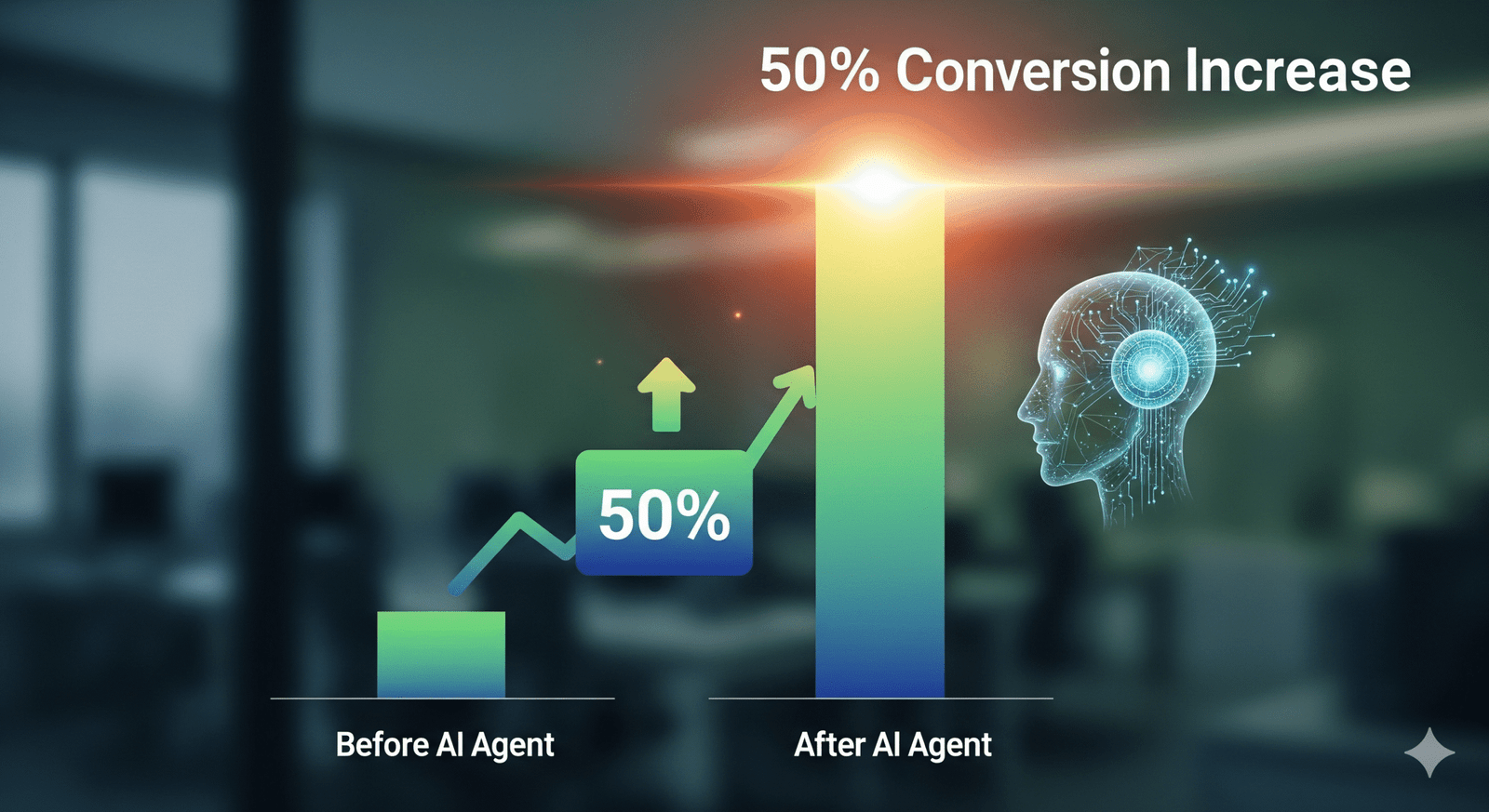
The headline result: a 52% increase in the qualified demo request conversion rate
This was the primary goal, and the results exceeded expectations.
- Before AI Agent: FinPro’s website visitor-to-demo conversion rate was 0.50%.
- After 6 Months with AI Agent: The conversion rate had climbed to 0.76%. This represents a 52% increase in the website’s primary conversion metric.
The secondary metrics that prove the powerful business impact
The increase in conversions was just the beginning. The AI agent had a cascading positive effect on the entire sales funnel.
- A dramatic increase in lead volume: The 52% increase in the conversion rate, applied to their existing traffic, resulted in a direct increase in the number of qualified demos booked per month, from an average of 50 to 76.
- A 40% reduction in the sales cycle: By eliminating the manual back-and-forth of scheduling, the average time from a prospect’s first website visit to a completed demo was reduced from 10 days to just 6 days.
- A 30% lift from after-hours engagement: A full 30% of all the demos booked by the AI agent were scheduled outside of FinPro’s standard 9-to-5 business hours. These were highly motivated leads that, under the old model, would have almost certainly been lost.
- A massive boost to sales team efficiency and morale: The sales team reported spending approximately 50% less time on manual prospecting and qualification. This allowed them to dedicate their time to what they did best: conducting high-quality demos and closing deals.
| Metric | Before AI Agent | After AI Agent (6 Months) | Change |
| Visitor-to-Demo Conversion Rate | 0.50% | 0.76% | +52% |
| Qualified Demos Booked/Month | 50 | 76 | +26 |
| Average Sales Cycle (First Visit to Demo) | 10 days | 6 days | -40% |
| Leads Captured Outside Business Hours | ~0% | 30% | +30% |
Exportálás Táblázatok-fájlba
The new growth engine: lessons from an AI-powered transformation
The story of FinPro Solutions is a powerful testament to the transformative potential of AI in the B2B sales and marketing process. Their success was not the result of a secret trick or a magic bullet. It was the result of a strategic decision to stop using their website as a passive, one-way brochure and to start treating it as an active, intelligent, and conversational member of their sales team.
The lessons from this transformation provide a clear blueprint for any business looking to achieve similar results:
- Engage, don’t just display: The modern customer expects a two-way conversation. Use technology to proactively engage your visitors, understand their needs, and offer immediate, helpful guidance.
- Automate the routine, humanize the relationship: Delegate the repetitive, data-driven tasks of initial engagement and qualification to an AI agent. This liberates your human team to focus their rare and valuable skills on the complex, nuanced, and relationship-building conversations that actually close deals.
- Treat your website as a 24/7 team member: Your website is your hardest-working employee. Empower it with the intelligence it needs to do its job: to welcome every visitor, to answer every question, and to ensure that no qualified lead ever walks out of your digital store unheard.
The technology to build this 24/7 sales engine is no longer the exclusive domain of Silicon Valley giants. It is accessible, practical, and delivers a staggering and rapid return on investment. This case study is not just a story of one company’s success; it is a clear and replicable blueprint for the future of B2B sales and marketing.
Leave a Reply