
For the past two decades, the digital marketing agency has been the essential partner for any business serious about growth. They have been our guides through the complex, ever-changing landscapes of search engines, social media, and online advertising. We’ve relied on their human expertise to build our websites, write our content, and manage our ad spend. This partnership, built on a foundation of human talent and creativity, has launched brands and built empires.
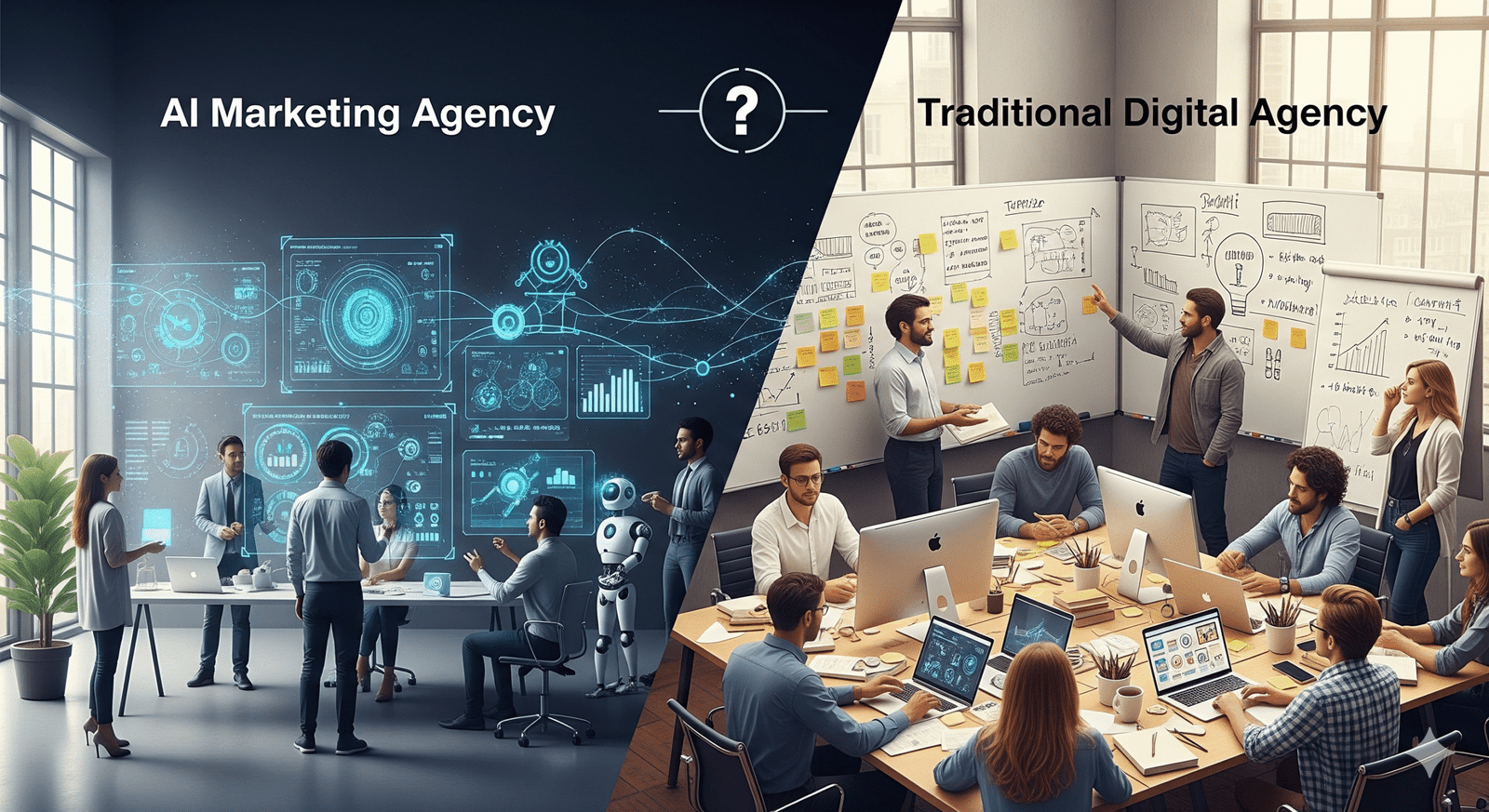
But the ground beneath us is undergoing a seismic shift. The very nature of the digital landscape is being reshaped by the most powerful technological force of our generation: Artificial Intelligence. This transformation is creating a new, fundamental divide in the agency world. On one side stands the traditional digital agency, built on a model of human-powered execution. On the other side, a new type of partner is emerging: the AI marketing agency, built on a new model of technology-augmented strategy.
On the surface, they may seem to offer the same services: SEO, content marketing, paid media. But underneath, their operational DNA, their core philosophy, their speed, and their capabilities are profoundly different. As a marketing strategist who has been on both sides of the client-agency table for 20 years, I can tell you that understanding this difference is now the most critical decision a business leader can make when choosing a partner for growth.
This is not just a question of using the latest tools. It is a fundamental choice between two different operating systems for your marketing. This guide is a deep, comparative analysis designed to provide clarity. We will deconstruct the traditional agency model, define the new AI-powered paradigm, and put them head-to-head across the key functions of marketing, so you can make an informed, strategic decision about which type of partner is truly built to navigate the future.
The foundation: a deep dive into the traditional digital agency model
To understand the revolution, we must first have a clear and respectful understanding of the old world order. The traditional digital agency model has been incredibly successful and is built on a foundation of skilled human capital.
The philosophy: human-powered execution
The core value proposition and business model of a traditional agency is the expertise and time of its people. You are essentially hiring a team of outsourced human specialists—an SEO expert, a copywriter, a graphic designer, a social media manager. Their primary resource is the “billable hour,” and their success is a direct result of the talent and hard work of the individuals on your account.
The structure: a collection of specialized, siloed departments
Most traditional agencies are structured like a classic professional services firm, with distinct departments based on function:
- The SEO Department
- The Paid Media (PPC) Department
- The Content Creation Department
- The Social Media Department
- The Web Development Department
Each of these departments functions as a center of excellence in its specific discipline. They have their own processes, their own key performance indicators (KPIs), and often, their own culture. While this fosters deep expertise in each area, it is also the model’s greatest weakness.
The workflow: a linear, manual, and often fragmented process
A typical campaign in a traditional agency flows in a linear, waterfall-like sequence from one silo to the next.
- Strategy: A senior strategist or account manager conducts manual research and creates a static strategy document or a campaign brief.
- Creation: The brief is passed to the content and creative teams, who write the copy and design the assets.
- Execution: The assets are then passed to the channel specialists (the SEO, PPC, and social media teams) for implementation.
- Reporting: At the end of the month, each department pulls its own data, which is then manually compiled by an account manager into a single, backward-looking PDF report.
The problem with this model is that it is slow, rigid, and lacks a cohesive feedback loop. An important insight discovered by the PPC team might not make it back to the content team for weeks, if at all.
The new paradigm: defining the modern AI marketing agency model
The AI marketing agency is not just a traditional agency that has bought a few new software subscriptions. It represents a fundamental re-architecting of the entire agency philosophy, structure, and workflow.
The philosophy: technology-augmented strategy
The core value proposition of an AI agency is not just the expertise of its people, but the powerful leverage it gains by augmenting that human expertise with artificial intelligence. The primary resource is not the billable hour, but data-driven insight. The goal is to use AI to automate the 80% of marketing work that is repetitive and data-intensive, in order to free up the senior human experts to focus on the 20% that is strategic, creative, and relationship-oriented.
The structure: an integrated, cross-functional “growth team”
An AI agency breaks down the traditional silos. Instead of separate departments, clients are served by an integrated, cross-functional “growth team.” This team, comprising a senior strategist, a data analyst, and a creative lead, works collaboratively on a single, unified strategy. They are all looking at the same data, working towards the same business goals, and using a shared AI-powered intelligence platform as their central “brain.”
The workflow: a dynamic, iterative, and highly automated process
The workflow in an AI agency is not a linear waterfall; it is a continuous, agile, and iterative cycle.
- Real-Time Insight: The process is driven by a continuous stream of AI-generated insights about the market, the competitors, and the client’s performance.
- Augmented Creation: Content and campaign creation is a collaborative “centaur” process, with AI handling the initial research and drafting, and humans providing the final strategic and creative input.
- Automated Execution: Many tactical tasks, like ad campaign optimization and lead nurturing sequences, are handled autonomously by AI agents, guided by human-set strategic goals.
- Live Reporting: Reporting is not a monthly event. It is a 24/7, real-time dashboard that provides not just descriptive data (what happened) but predictive and prescriptive insights (what will happen, and what we should do about it).
The ultimate showdown: a practical comparison of key marketing functions
Let’s put the two models head-to-head across the most critical marketing functions to see the tangible differences in their capabilities and outputs.
Strategic planning and market research
- Traditional agency: The process often begins with a series of manual, time-consuming research tasks. An SEO specialist might spend a week exporting thousands of keywords into a spreadsheet and trying to manually group them. A strategist might spend days manually reviewing competitor websites. The result, often delivered after several weeks, is a static PowerPoint presentation outlining a 6- or 12-month plan based on a snapshot in time.
-
AI agency: The process is radically different. The strategist uses an AI-powered intelligence platform. They input the client’s domain and a list of competitors. In a matter of minutes, the AI performs a comprehensive analysis that would take a human team weeks. It delivers:
- A complete topic cluster map, identifying the core themes and content gaps in the market.
- A deep competitive analysis, revealing the precise strategies competitors are using to win.
- Predictive trend forecasts, identifying emerging topics before they become mainstream. The output is not a static plan, but a dynamic, data-driven strategic roadmap that can be adapted in real-time as the market shifts.
Content creation and SEO
- Traditional agency: The workflow is linear. A strategist creates a brief based on keyword research. A copywriter writes the article. An SEO specialist then “optimizes” it, often awkwardly inserting keywords after the fact. The process is slow, and the result is often a compromise between readability and optimization.
-
AI agency: The process is integrated and collaborative.
- The AI generates a data-driven content brief that is already perfectly aligned with SEO best practices, based on a real-time analysis of the top-ranking content.
- A generative AI creates a comprehensive first draft.
- The human writer and subject matter expert then focus their time on the highest-value tasks: adding unique insights, injecting the brand’s voice and storytelling, and providing the genuine, first-hand Experience and Expertise that Google’s E-E-A-T guidelines demand. The result is content that is both scientifically engineered to rank and authentically compelling for a human audience, produced in a fraction of the time.
Paid media management
- Traditional agency: A human campaign manager manually sets up campaigns in Google Ads or Meta. They write a few ad variations, set their bids based on experience and historical data, and then check in periodically to make manual adjustments. They are limited in the number of variations they can test and the speed at which they can react.
-
AI agency: The human manager’s role is elevated to that of a strategist. They define the campaign goal, the target audience, and the creative direction. The tactical execution is then delegated to the platform’s AI.
- The AI generates and tests hundreds or even thousands of creative combinations (headlines, images, copy).
- It uses a multi-armed bandit algorithm to automatically and continuously shift the budget to the best-performing ads in real-time.
- It performs predictive, real-time bidding, adjusting the bid for every single auction based on the predicted conversion probability of that specific user. The human strategist oversees the AI, analyzes its findings, and makes high-level strategic decisions, while the AI handles the millions of micro-optimizations that are humanly impossible.
Reporting and analysis
- Traditional agency: The end of the month is a flurry of activity as account managers manually pull data from a dozen different sources (Google Analytics, Google Ads, social media platforms, etc.) and compile it into a backward-looking PDF report that is often outdated by the time the client reads it.
- AI agency: The report is a live, 24/7, automated dashboard. The AI integrates all data sources into a single, unified view. But it does more than just display data. It provides proactive insights. The AI can automatically detect anomalies and send an alert: “Warning: Your organic traffic from mobile devices has dropped 30% in the last 48 hours. This correlates with a recent drop in your Core Web Vitals score for mobile.” This transforms reporting from a historical record into a real-time, proactive management tool.
Choosing your future: which model is right for your business?
The choice between a traditional agency and an AI agency is not a simple question of “old vs. new.” It is a strategic decision about the type of partnership and the operational model that best fits your business’s goals, culture, and ambition.
The traditional agency offers a team of skilled human artisans. They craft your marketing with familiar, time-tested methods, and their value is rooted in the deep experience and creative intuition of their people. It is a model built on human effort.
The AI agency, on the other hand, offers a team of strategic human architects who command a powerful, intelligent technological workforce. Their value is rooted in their ability to use data and technology to create a strategic advantage. It is a model built on intelligent leverage.
In the accelerating, data-drenched market of today, the limitations of a purely human-effort model are becoming increasingly clear. The future of marketing is not about replacing human talent, but about augmenting it with the power of the machine. It’s about building a smarter, faster, and more effective engine for growth. The agency of the future is not a collection of siloed departments; it is an integrated, intelligent growth partner. And that future is here today.
Leave a Reply