

For the last century, the great revolutions in business have been driven by new ways of organizing labor and energy. The assembly line, the personal computer, the internet—each one was a seismic shift that created new empires and turned yesterday’s titans into footnotes in a history book. We are living through the opening chapters of the next great revolution right now. It is not a revolution of steam or silicon, but of intelligence itself. It is the dawn of the autonomous AI Agent.
For many business leaders, the term “Artificial Intelligence” still feels abstract, a futuristic buzzword confined to the world of tech giants. But this is a dangerous misconception. As a strategist who has spent two decades guiding businesses through technological disruption, I can tell you with certainty that AI is no longer a future-state technology; it is a present-day competitive necessity. And the most transformative application of this technology is the AI Agent—an intelligent, autonomous digital employee capable of executing complex tasks 24/7.
This is not a guide about the AI tools you may already be using, like a simple chatbot or a content writing assistant. This is a strategic briefing on a fundamentally new class of technology that is moving beyond mere assistance to true autonomy. This article will deconstruct what an AI Agent is, explore how it is poised to revolutionize the core functions of every modern business, and make the clear, data-driven case for why integrating this technology is no longer an option, but an essential strategy for survival and growth in the coming decade.
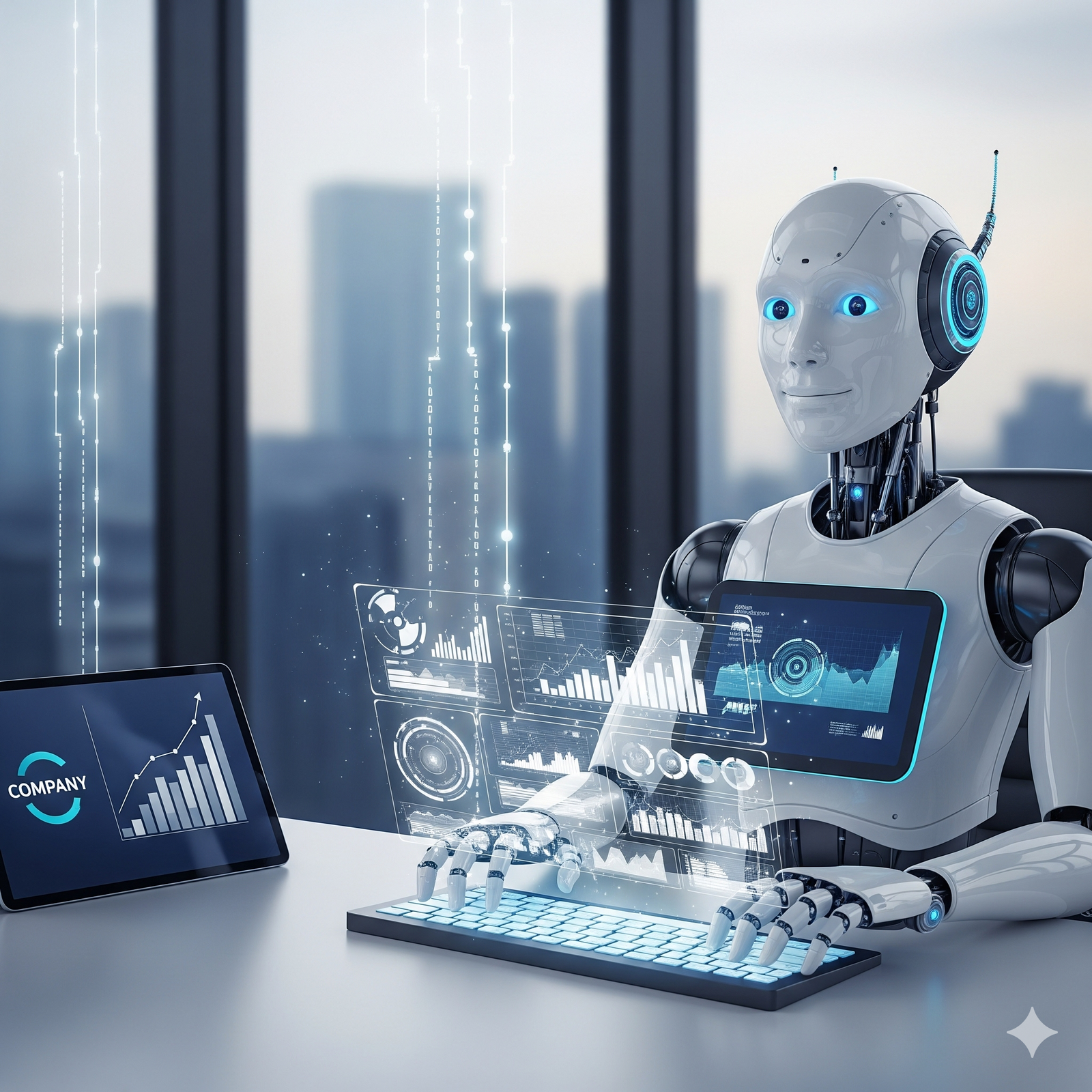
What is the profound difference between AI tools and AI agents?
To grasp the magnitude of this shift, we must first draw a crystal-clear distinction between the AI tools that have become popular and the AI agents that are now emerging. The difference is as significant as the difference between a power drill and a team of autonomous construction robots.
The era of the intelligent tool: the first wave of AI
The first wave of the AI revolution, which we are all now familiar with, was about creating intelligent tools that augmented human capabilities.
- They are passive and task-oriented: A tool like ChatGPT or a graphic design AI waits for a specific command from a human operator. You prompt it, it responds. You ask it to perform a single task, and it executes that task.
- They require constant human direction: The human user is the project manager, the strategist, and the quality control specialist. We must break down a large project into a series of small, sequential tasks and feed them to our AI tools one by one. The intelligence of the output is a direct result of the intelligence of the human’s prompts.
These tools are incredibly powerful and have already delivered massive productivity gains. But they are still fundamentally levers that a human must pull.
The dawn of the autonomous workforce: the second wave of AI
An AI Agent represents the second, far more powerful wave. An agent is not a passive tool; it is a proactive, goal-oriented system designed to operate with a significant degree of autonomy. It is defined by three core capabilities that set it apart:
- A goal-oriented mindset: You don’t give an agent a single, specific task. You give it a high-level goal. For example, a business leader doesn’t tell it to “write an email.” They tell it, “Our goal is to reduce customer churn by 15% this quarter.”
-
Autonomous planning and execution: This is the revolutionary leap. Based on the high-level goal, the agent can independently devise a multi-step plan to achieve it. To reduce churn, the agent might autonomously decide to:
- Analyze our CRM data to identify customers showing signs of disengagement.
- Design a personalized re-engagement email campaign.
- Draft different versions of the email copy for different customer segments.
- Schedule the campaign to be sent at the optimal time for each user.
- Monitor the results.
- Learning and self-optimization: An agent has a feedback loop. It analyzes the results of its own actions and adapts its future behavior based on what it has learned. If it discovers that a re-engagement offer of “a free consultation” is more effective than a “10% discount” for high-value clients, it will automatically adjust its own strategy for the next campaign.
An AI tool is like a brilliant but very literal freelance copywriter who you must manage step-by-step. An AI agent is like a data-driven, highly motivated marketing manager who you can give a quarterly objective to, and who will then work autonomously to achieve it. This is the fundamental difference, and it is changing everything.
The three core business functions being transformed by AI agents
The impact of this new, autonomous workforce is not confined to a single department. AI agents are poised to revolutionize the three most critical, customer-facing functions of any modern business: Marketing, Sales, and Customer Service.
Revolutionizing marketing: from reactive guesswork to a predictive science
The traditional marketing department is often a chaotic whirlwind of reactive tasks. An AI Marketing Agent transforms it into a proactive, data-driven intelligence unit.
- The AI market research agent: This agent acts as your 24/7 market analyst. Its goal is to “identify and report on emerging market trends and competitor strategies in our industry.” It autonomously scans thousands of news articles, social media conversations, patent filings, and competitor websites. It doesn’t just deliver a report of what happened last month; it uses predictive analytics to identify “weak signals” and forecast emerging trends, giving your leadership team a critical first-mover advantage.
- The AI content strategist agent: Its goal is to “achieve topical authority in our core areas of expertise.” It analyzes the entire search landscape, identifies content gaps, performs deep keyword and topic clustering, and generates a data-driven content calendar. It then collaborates with a generative AI and your human experts to produce high-quality, SEO-optimized content at a scale and speed that is impossible to achieve manually.
- The AI paid media agent: Its goal is to “generate a target number of qualified leads within a specific budget.” This agent autonomously manages your ad campaigns on platforms like Google and Meta. It performs thousands of micro-experiments, testing different ad creatives, audience segments, and bidding strategies in real-time. It continuously and automatically shifts your ad spend to the best-performing combinations, maximizing your return on investment (ROI) with a level of efficiency that no human team can match.
Revolutionizing sales: from cold calls to intelligent, automated conversations
The traditional B2B sales process is notoriously inefficient, with highly-paid salespeople spending the majority of their time on low-value prospecting and qualification tasks.
-
The AI sales development representative (SDR) agent: This is perhaps the most powerful application. This agent lives on your website, acting as your tireless, 24/7 sales qualifier. Its goal is to “engage with every website visitor, qualify their needs against our Ideal Customer Profile, and book a meeting with a human salesperson for all qualified leads.”
- It engages proactively: Based on a visitor’s behavior, it initiates a helpful, conversational chat.
- It qualifies intelligently: It asks a series of nuanced questions, using NLP to understand the free-form answers.
- It converts frictionlessly: For qualified leads, it integrates with your sales team’s live calendars and books a meeting instantly, eliminating the slow and frustrating back-and-forth of scheduling emails.
- The result on the human team: This completely transforms the role of your human sales team. They are liberated from the grind of cold prospecting and manual qualification. They arrive at work to a calendar populated with pre-qualified, high-intent meetings. The AI agent provides them with a complete “intelligence briefing”—including the full chat transcript and a summary of the prospect’s needs—before every single call. This allows your human team to focus 100% of their energy on what they do best: building relationships and closing high-value deals.
Revolutionizing customer service: from a costly burden to a proactive loyalty engine
The traditional customer service center is a major cost center, constantly battling high ticket volumes and agent burnout.
-
The AI frontline support agent: This agent acts as the first point of contact for all customer inquiries. Its goal is to “instantly resolve all common and repetitive customer issues.”
- It provides instant, 24/7 resolution: By integrating with your knowledge base and backend systems, it can instantly answer the 80% of routine questions like “Where is my order?” or “How do I reset my password?” at any time of day or night.
- It performs intelligent triage: For the 20% of issues that are complex, emotional, or require human intervention, the agent intelligently categorizes the problem and routes it to the correct human specialist, providing them with the full context of the conversation.
- The proactive service agent: The agent’s role goes beyond just reacting to problems. It can analyze a customer’s data and predict potential issues before they happen. For example, it might identify a customer whose usage of a software product indicates they are struggling with a specific feature. The agent can then proactively send them a helpful tutorial video or an invitation to a training webinar. This transforms customer service from a reactive “fire-fighting” function into a proactive, churn-reducing loyalty engine.
The strategic imperative: why this is a CEO-level decision for every business
The adoption of AI agents is not a decision that can be delegated to the IT department or a single marketing manager. It is a fundamental, CEO-level strategic decision about the future operational model of your entire company.
The impact on your operational model and cost structure
AI agents introduce a new and incredibly powerful concept into your business: scalable, intelligent labor at near-zero marginal cost. Once an agent is trained and implemented, it can handle ten, a thousand, or a million conversations with the same level of efficiency. This fundamentally changes the economics of scaling your business. You can now grow your capacity to engage with customers without linearly growing your human headcount and its associated costs. This creates a massive operational leverage and a significant competitive advantage.
The future of human work: augmenting your most valuable asset
This is not a story about replacing people. It is a story about making your people more valuable. The most successful companies of the next decade will be those that master the art of the human-AI collaboration. By delegating the repetitive, data-intensive, and scalable tasks to AI agents, you free up your human team to focus on the skills that are, and will always be, uniquely human:
- High-level strategic thinking and complex problem-solving.
- Creativity, innovation, and brand building.
- Empathy and deep, trust-based relationship building.
- Ethical leadership and judgment.
The risk of inaction: the “Kodak moment” of the AI era
The history of business is filled with stories of market leaders who failed to adapt to a fundamental technological shift. Kodak invented the digital camera but failed to embrace it. Blockbuster had the chance to buy Netflix but dismissed it as a niche business. The decision to ignore the rise of AI agents is, for many businesses, a “Kodak moment” in the making. Your competitors—both established players and new, agile startups—are already integrating this technology into their operations. They are becoming faster, smarter, and more efficient every single day. The gap between the AI-augmented businesses and the purely manual ones will grow exponentially, and catching up will soon become impossible.
The intelligent enterprise: your new operational blueprint
The shift from a human-powered organization to a human-led, AI-augmented organization is the single most important business transformation of our time. It requires a new way of thinking, a new organizational structure, and a new approach to leadership.
The journey begins not with a massive technological investment, but with a simple strategic question: What are the most repetitive, low-value, and scalable tasks that are currently consuming our most valuable human talent?
By identifying these bottlenecks and strategically deploying intelligent AI agents to solve them, you are not just adopting a new piece of software. You are building a new kind of company. You are creating a smarter, faster, and more resilient organization that is not just prepared for the future, but is actively building it. The AI agent is no longer on the horizon; it is here, ready to be put to work. The only question is whether it will be working for you, or for your competition.
Leave a Reply