
There is a relentless, insatiable beast at the heart of modern marketing, and its name is social media. It demands to be fed constantly—with fresh content, with witty captions, with instant replies, and with 24/7 engagement. For the social media manager, the brand strategist, or the small business owner trying to do it all, this reality has created a state of perpetual motion, a frantic, burnout-inducing treadmill of creation and reaction. We are expected to be copywriters, graphic designers, video editors, community managers, and data analysts, all at once, across five or more different platforms.
For years, the solution to this overwhelming demand was a set of simple scheduling tools. Platforms like Buffer and Hootsuite were a lifeline, allowing us to plan our posts in advance. But they only solved a tiny fraction of the problem. They didn’t help us come up with what to post, and they certainly didn’t help us manage the ever-growing flood of comments, questions, and direct messages that are the reward for successful content. The paradox of social media has always been that the more successful you are, the more overwhelming the work becomes.
As a media and marketing strategist who has witnessed the evolution of digital communication from the early days of forums to the global dominance of TikTok, I can tell you that we are at the beginning of a new, transformative era. Artificial Intelligence is not just another tool to add to our marketing stack; it is a fundamental shift in how we manage our digital presence. It’s the arrival of a powerful new partner, an intelligent co-pilot that can handle the repetitive, scalable tasks, freeing up human marketers to focus on what they do best: strategy, creativity, and building authentic human connections.
This is not a guide about letting robots take over your brand’s voice. It is a strategic playbook on how to use AI to build a social media workflow that is more efficient, more intelligent, and, paradoxically, more human than ever before. We will explore how AI is revolutionizing both automated posting and community engagement, and provide a clear framework for how you can integrate this technology to escape the content treadmill and start building a truly thriving online community.
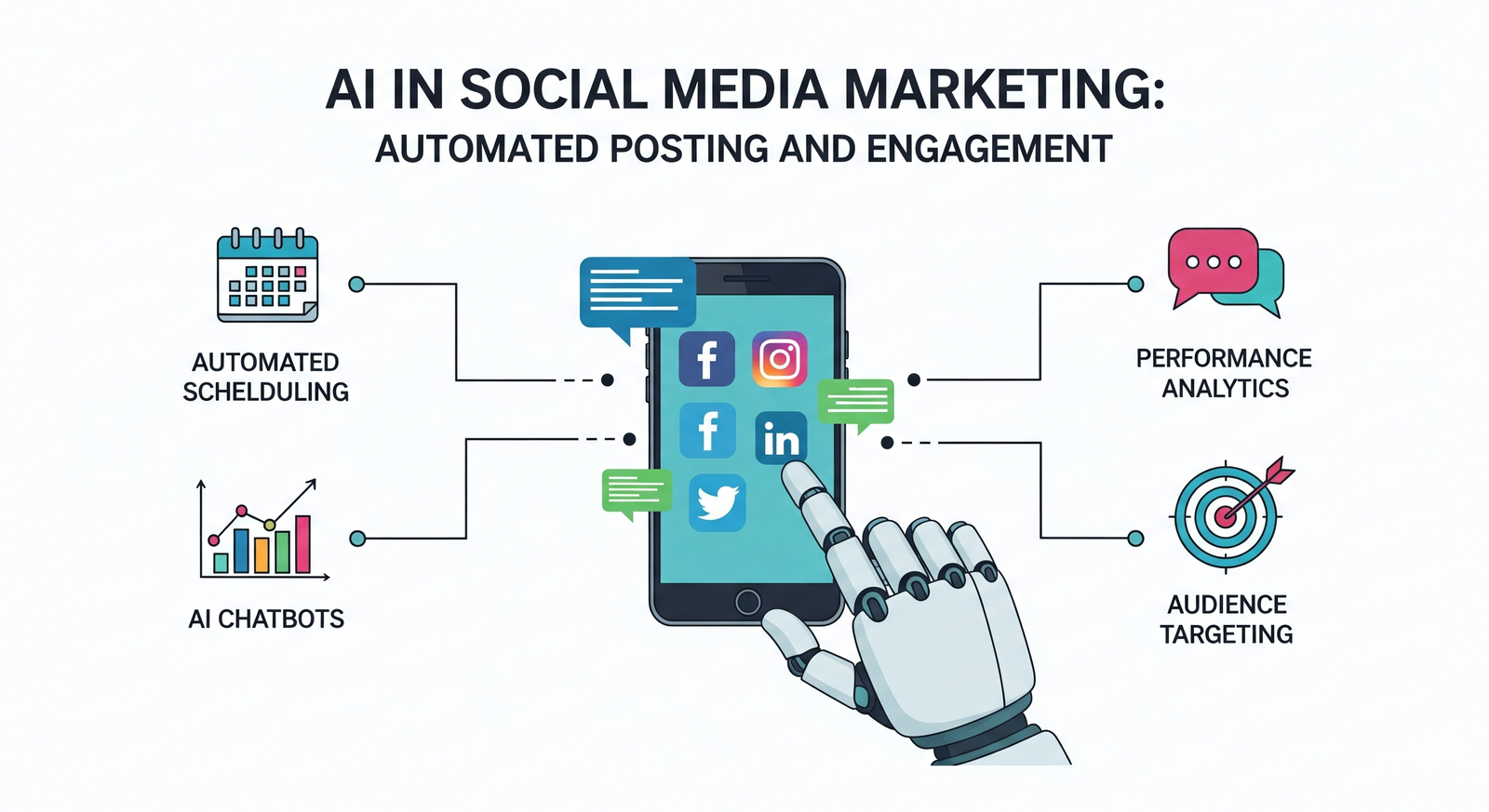
The relentless 24/7 news cycle: why manual social media management is a broken model
To understand the solution, we must first be brutally honest about the problem. The traditional, manual approach to social media management is fundamentally unsustainable in the long term.
The content creation treadmill: feeding the beast
The demand for high-quality, platform-specific content is immense and never-ending. A strategy that works on LinkedIn will fail on Instagram. A video that thrives on TikTok will fall flat on Twitter. A manual workflow for this requires a constant, draining cycle of:
- Brainstorming: What should we post about today? This week? This month?
- Creation: Writing copy, designing graphics, editing short videos.
- Scheduling: Manually populating a content calendar for each platform. This process is a relentless grind that often leaves little room for high-level strategic thinking or genuine creativity.
The engagement paradox: the punishment for success
The ultimate goal of social media is to foster a community and create a two-way conversation. But what happens when you succeed?
- The flood of comments: A viral post can generate thousands of comments. Manually reading, filtering, and responding to even a fraction of these is a monumental task.
- The expectation of instant response: In our on-demand world, customers who ask a question in a direct message or a comment expect a fast reply. A 24-hour response time is no longer acceptable.
- The result: As a brand grows, the volume of engagement becomes impossible for a human team to manage. Questions go unanswered, comments are ignored, and the “community” feeling that the brand worked so hard to build begins to erode under the weight of its own success.
The data overload problem and the “always on” pressure
Every social media platform provides its own analytics dashboard, with its own unique set of metrics. Manually compiling this data into a coherent, cross-platform report to understand what’s truly working is a complex and time-consuming task. On top of all this, social media never sleeps. A customer complaint can escalate at 2 AM on a Saturday, or a new trend can emerge overnight. The pressure for the social media manager to be “always on” is a direct path to burnout.
The rise of the AI co-pilot: deconstructing the technology for social media
AI provides a powerful set of solutions to these challenges. The technology can be broken down into three key areas that directly map to the needs of a modern social media manager.
Generative AI for supercharged content creation
This is the most visible and widely discussed application of AI. Large Language Models (LLMs) like GPT-4 and AI image generators like Midjourney or DALL-E are transforming the creative process.
- How it works: These models are trained on vast datasets of text and images, allowing them to understand and generate new, original content based on a user’s prompt.
-
Its capabilities for social media:
- Brainstorming and Ideation: It can generate dozens of post ideas, different angles for a campaign, or creative hooks for a video.
- Drafting and Copywriting: It can write first drafts of captions, tweets, and LinkedIn articles.
- Visual Creation: It can generate unique images, illustrations, or concept art for posts.
- Content Repurposing: This is a key strength. It can take a long-form blog post and automatically transform it into a series of tweets, a script for a short video, or a set of key takeaways for an Instagram carousel.
Natural language processing (NLP) for intelligent engagement and social listening
This is the AI’s ability to “read” and understand the vast ocean of conversation happening on social media.
- How it works: NLP algorithms can analyze text to determine its meaning, sentiment, and intent.
-
Its capabilities for social media:
- Sentiment Analysis: It can automatically classify brand mentions as positive, negative, or neutral, giving you a real-time pulse on your brand’s reputation.
- Intent Recognition: It can understand the purpose behind a user’s comment. Is it a pre-sales question? A customer support issue? A simple compliment? Or a spam comment?
- Trend Identification: It can analyze millions of conversations to identify emerging topics, viral hashtags, and shifts in consumer behavior.
Predictive analytics for optimized timing and strategy
This involves using machine learning to analyze your own historical performance data to make smarter decisions about the future.
- How it works: An ML model can analyze all of your past posts and identify the complex patterns that lead to success.
-
Its capabilities for social media:
- Optimal Scheduling: It can analyze your specific audience’s engagement patterns on each platform and predict the absolute best day and time to publish a post for maximum reach and interaction.
- Performance Forecasting: It can predict the likely engagement rate of a draft post based on its topic, format, and copy, allowing you to refine your content before it even goes live.
AI in action: automating your social media workflow for maximum impact
Let’s move from theory to a practical, step-by-step look at how these AI capabilities can be integrated into your daily social media workflow.
Revolutionizing content posting and scheduling: the intelligent content engine
The goal here is to transform the content creation process from a manual grind into a strategic, AI-augmented workflow.
- Step 1: AI-powered ideation and strategic planning: The process begins with a strategic goal. Instead of asking “What should we post today?”, you ask the AI, “Generate a content plan for the next month for a brand that sells sustainable coffee, focusing on the themes of ethical sourcing and home brewing techniques.” The AI can provide a complete calendar with daily topic ideas, suggested formats (e.g., “Monday: ‘Meet the Farmer’ Instagram post; Tuesday: ‘Brewing Tip’ TikTok video”), and relevant hashtags.
-
Step 2: augmented content creation: The human social media manager then acts as a creative director.
- For copy: They take the AI’s topic idea (“Brewing Tip: The Perfect Water Temperature”) and use a generative AI to draft a few caption options. They then select the best one and refine it with the brand’s unique voice.
- For visuals: They can use a prompt like, “Create a photorealistic, top-down shot of a beautifully brewed pour-over coffee, with steam rising, on a rustic wooden table.” The AI image generator provides several options, and the manager chooses the most compelling one.
- Step 3: intelligent, automated scheduling: The finalized content is then uploaded to an AI-powered social media management platform. The manager no longer has to guess the best time to post. They simply assign the post to a queue, and the AI’s “intelligent scheduling” or “optimal send time” feature analyzes that specific platform’s real-time audience data and automatically publishes the post at the precise moment it is most likely to achieve maximum engagement.
Revolutionizing community management and engagement: your 24/7 first responder
This is where AI provides perhaps its most significant value, solving the “engagement paradox” and allowing a brand to provide exceptional customer service at scale.
- The AI as the first point of contact: An AI agent is connected to all your social media inboxes and mentions, acting as your vigilant, 24/7 first responder.
-
Step 1: automated triage and categorization: The agent uses NLP to instantly analyze and categorize every single incoming message and comment.
- Simple, common questions: Queries like “Do you ship to Canada?” or “What are your store hours?” are instantly identified.
- Sales opportunities: Comments like “Wow, I need this! Where can I buy it?” are flagged as high-intent sales leads.
- Positive sentiment: Glowing comments and positive testimonials are identified and collected.
- Negative sentiment and urgent issues: Frustrated customer complaints or technical support questions are immediately flagged as high-priority.
-
Step 2: intelligent, automated action: Based on this categorization, the agent takes a series of autonomous actions.
- For simple questions: The agent provides an instant, pre-approved answer from its knowledge base. The customer gets an immediate resolution, and no human time is spent.
- For sales opportunities: The agent can respond with a direct link to the product page or even create a draft reply for a human salesperson to personalize and send.
- For positive mentions: The agent can flag these for the marketing team, who can then ask the user for permission to feature their comment as a testimonial.
- For urgent complaints: This is the most critical workflow. The agent can automatically create a high-priority support ticket in your customer service system (like Zendesk or Salesforce Service Cloud) and send an alert to the on-call human support agent, ensuring that critical issues are addressed in minutes, not hours.
- Step 3: AI-assisted human response: For comments that require a human touch but are not urgent, the AI can still help. It can provide a draft of an empathetic, on-brand response for the human community manager to quickly review, edit, and post. This allows a single human to manage a volume of engagement that would have previously required a large, multi-shift team.
The new command center: your strategy for a human-AI hybrid team
The vision of an AI-powered social media strategy is not one of empty, robotic automation. It is a vision of a smarter, more efficient, and more human-centric operation. The goal is to use the machine’s strengths—speed, scale, and data analysis—to free up the human’s unique strengths: strategy, creativity, empathy, and genuine connection.
In this new model, the role of the social media manager evolves dramatically. The social media manager of the past was a content creator, a fast-typer, and a jack-of-all-trades, constantly running on a treadmill. The social media manager of the future is a community architect, a brand strategist, and an AI orchestrator.
- They set the strategy: They define the high-level goals, the campaign themes, and the brand’s voice, which guide the AI agents’ actions.
- They handle the most important conversations: They are freed from answering “Where is my order?” a hundred times a day, so they can focus their energy on building genuine relationships with key influencers, delighting top customers, and handling sensitive issues with a masterful, empathetic touch.
- They are the creative directors: They guide the AI’s content creation efforts, curating the best ideas, refining the outputs, and ensuring that every single post is a true reflection of the brand’s soul.
This is the future of social media marketing. It is not a choice between a human or a machine. It is a seamless, powerful partnership between the two. By delegating the repetitive, the scalable, and the data-intensive tasks to your new AI co-pilot, you are not replacing the soul of your social media; you are finally giving it the time and the space it needs to truly shine.
Leave a Reply