
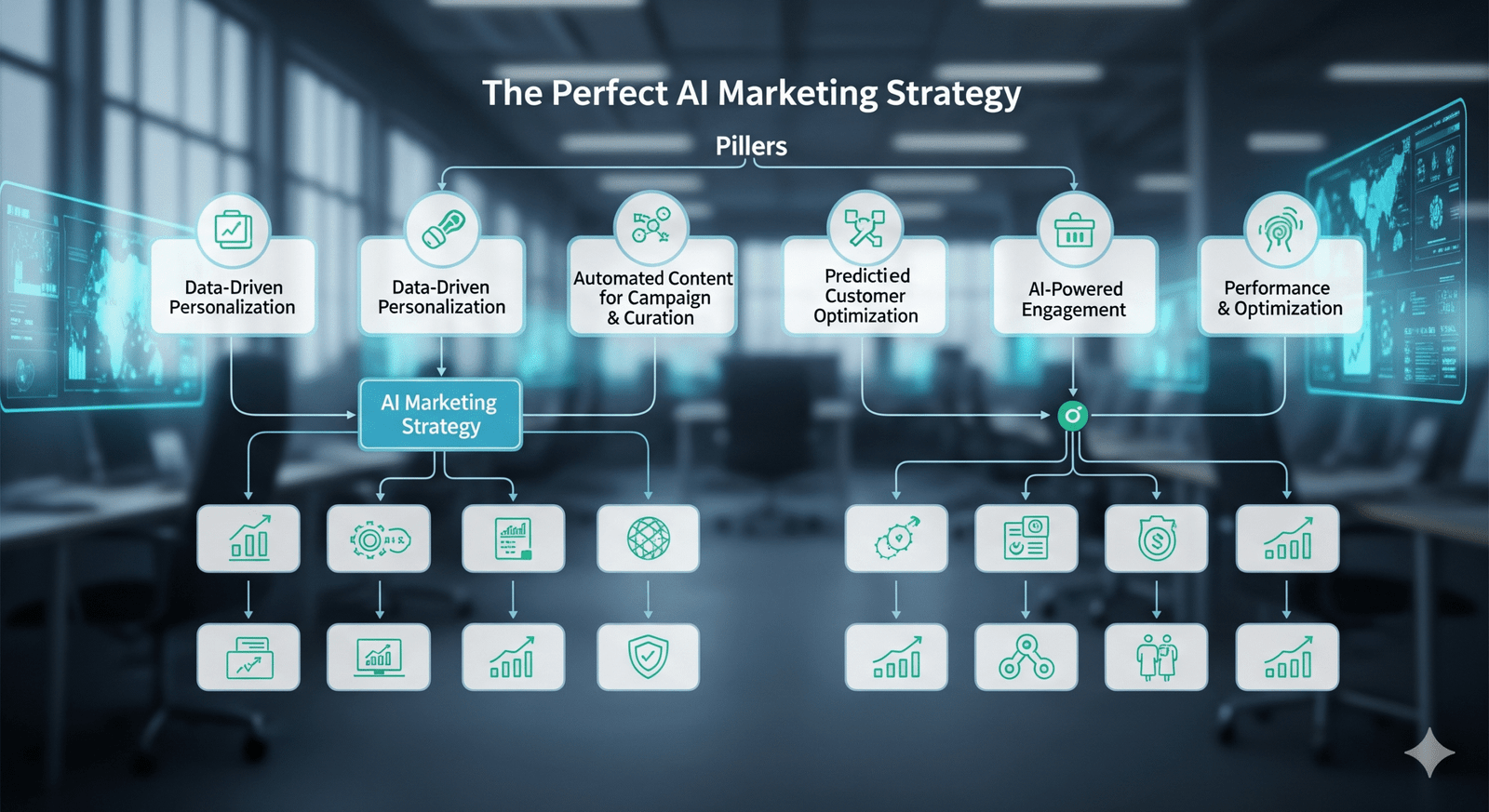
The world of marketing is in the grip of an AI-fueled whirlwind. Every day, a new tool is launched, a new capability is announced, and a new wave of hype and anxiety washes over business leaders and marketing teams. There is an immense pressure to “do something with AI,” a palpable fear of being left behind. This pressure often leads to a chaotic, reactive scramble—a rush to buy a subscription to the latest AI writer or to implement a chatbot without a clear plan, hoping that the technology itself will magically produce results.
But a tool is not a strategy. A powerful engine without a steering wheel and a destination is just a faster way to crash. As a marketing strategist who has guided companies through two decades of technological disruption, I have seen this pattern repeat itself. The businesses that succeed are never the ones that simply adopt new technology first; they are the ones that integrate that technology into a coherent, goal-oriented strategy.
Artificial intelligence is not a magic bullet. It is the single most powerful force multiplier for a well-designed marketing strategy that we have ever seen. But its power can only be unlocked when it is wielded with purpose. The biggest mistake a business can make in the AI era is to focus on the “what”—the tools—before they have a crystal-clear understanding of the “why”—the core business problem they are trying to solve.
This guide is the antidote to the chaos. It is a simple, powerful, and practical 5-step framework designed to help you build a robust and effective AI marketing strategy from the ground up. This is not a technical manual; it is a strategic blueprint. We will move beyond the buzzwords and provide a clear, logical process that will empower you to harness the true potential of AI, turning it from a source of confusion into your most powerful and predictable engine for business growth.
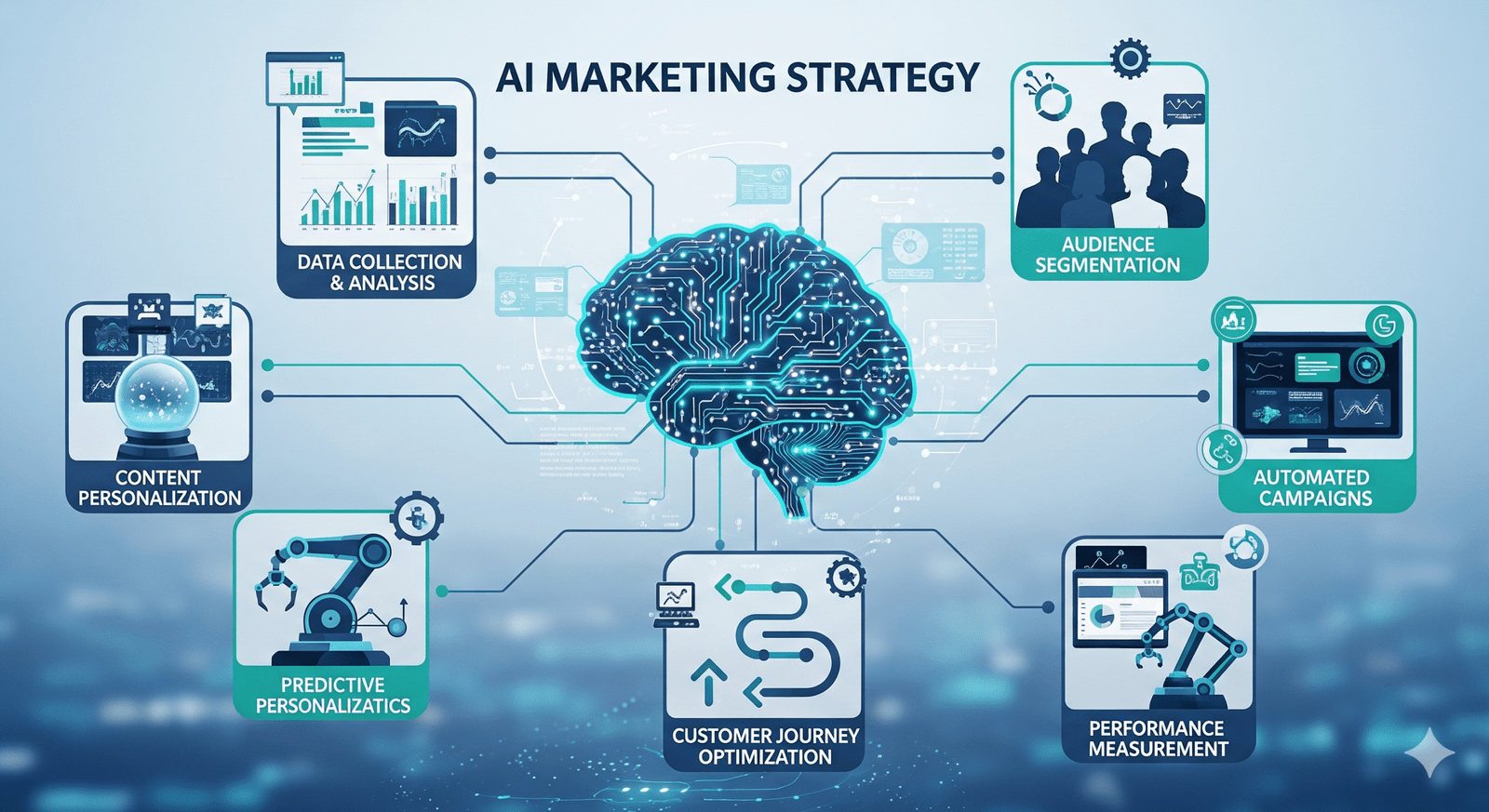
Step 1: define your core business objective – the “why” before the “what”
This is the most important, most foundational, and most frequently skipped step. Before you even think about AI tools or marketing tactics, you must answer one simple question: What is the single biggest business problem I am trying to solve, or the single biggest opportunity I am trying to capture?
The fallacy of a generic, one-size-fits-all AI strategy
There is no such thing as an “AI marketing strategy.” There is only a business strategy that is powered by AI. The way a B2B SaaS company uses AI to generate enterprise leads will be fundamentally different from how an e-commerce brand uses AI to increase repeat purchases. A strategy that begins with the technology is doomed to fail. A strategy that begins with the business goal has a clear path to success.
Identifying your single most important problem or opportunity
The power of AI is its ability to act as a specialist. To leverage it effectively, you must first define the specialty you need. Sit down with your leadership team and have an honest conversation. Where is your business feeling the most pain, or where does the greatest opportunity for growth lie? The answer will likely fall into one of these core categories:
- Lead generation: Is your primary challenge simply getting more, and better, leads into the top of your sales funnel? Is your sales team spending too much time on low-quality prospects?
- Conversion rate optimization: Do you have plenty of website traffic, but a frustratingly low percentage of those visitors are taking the desired action (e.g., making a purchase, requesting a demo)?
- Customer retention and lifetime value (LTV): Is your business struggling with customer churn? Are you failing to generate repeat business from your existing customer base?
- Operational efficiency and cost reduction: Is your marketing team bogged down in manual, repetitive tasks? Are your customer service costs spiraling out of control due to a high volume of simple, repetitive inquiries?
- Market expansion and intelligence: Do you need to gain a deeper understanding of a new market segment or stay ahead of emerging competitor strategies?
Choose one. This will become the North Star for your entire AI marketing strategy.
From a vague goal to a specific, measurable KPI
Once you have identified your primary objective, you must translate it into a specific, measurable, achievable, relevant, and time-bound (SMART) Key Performance Indicator (KPI).
- A vague goal: “We want to use AI to get more leads.”
- A powerful, strategic KPI: “Our goal is to use an AI-powered conversational agent to increase the number of marketing-qualified leads (MQLs) generated from our website by 30% over the next 6 months.”
This level of clarity is non-negotiable. It provides the focus needed to select the right tools, design the right processes, and, most importantly, to measure the success and ROI of your initiative.
Step 2: audit your data and technology – understanding your fuel and your engine
If your business objective is the destination, your data is the fuel, and your existing technology stack is the engine. Before you can start your journey, you need to take a clear-eyed inventory of what you have to work with.
Data as the essential fuel for any AI initiative
Artificial Intelligence is not magic; it is mathematics powered by data. The quality and accessibility of your data will directly determine the success of your strategy. It’s time to conduct a data audit.
-
Inventory your data sources: What data are you currently collecting?
- Website Analytics: Google Analytics data on traffic sources, user behavior, and conversion paths.
- CRM Data: Detailed information on your leads, customers, and their interaction history with your sales team.
- Transactional Data: Purchase history, average order value, product affinities from your e-commerce or billing platform.
- Customer Support Data: Transcripts from live chats, support tickets, and call logs. This is often a goldmine of customer pain points.
- Assess your data quality and integration: This is the most critical part. Are your data sources clean and well-organized? Or are they a chaotic mess of incomplete records and inconsistent formatting? More importantly, are your systems talking to each other? Is your website analytics data connected to your CRM? A unified view of the customer is the holy grail. An AI agent can only be as intelligent as the data it has access to. Identifying data silos and planning for their integration is a crucial part of your strategy.
Your existing technology stack as the engine
You may already be sitting on powerful AI capabilities that you aren’t even using.
- Inventory your current tools: Make a list of all the major software platforms your sales and marketing teams use: your CRM (e.g., Salesforce, HubSpot), your email marketing platform (e.g., Mailchimp, Klaviyo), your advertising platforms (Google Ads, Meta), and your CMS (e.g., WordPress).
- Identify hidden AI features: Many of these platforms have begun to build powerful AI features directly into their systems. Does your CRM have a predictive lead scoring feature that you haven’t activated? Does your email platform offer AI-powered send-time optimization? Understanding the capabilities you already pay for is the most cost-effective first step.
- Assess integration capabilities (APIs): A key consideration when choosing new AI tools is how well they will integrate with your existing stack. Does your CRM have an open API that would allow a new AI chatbot to automatically create and update lead records?
This audit phase will give you a clear and honest picture of your starting point. It will highlight your strengths (e.g., “We have 10 years of rich, clean CRM data”) and your weaknesses (e.g., “Our website data and sales data are completely disconnected”), which will be invaluable for the next step.
Step 3: select the right AI tools for the job – choosing your specialists
Armed with a clear business objective and an understanding of your data landscape, you are now ready to choose your tools. The key here is to think of it not as buying software, but as hiring a team of digital specialists. You wouldn’t hire a single person to be your writer, your data analyst, and your ad buyer. Similarly, you shouldn’t look for a single, magical “do-it-all” AI platform. You should choose the best specialist tool for the specific job you defined in Step 1.
Matching the AI tool to your core business objective
-
If your primary goal is to increase qualified lead generation:
- Your specialist agent: An intelligent conversational AI agent (a sophisticated chatbot).
- Why: This agent can engage with every website visitor 24/7, ask intelligent qualifying questions, and automatically book meetings for your sales team, transforming your website from a passive brochure into an active lead generation machine.
-
If your primary goal is to increase e-commerce sales and conversion rates:
- Your specialist agent: An AI-powered personalization and recommendation engine.
- Why: This agent can analyze a user’s real-time behavior to deliver one-to-one product recommendations, dynamic content on your homepage, and predictive exit-intent offers to reduce cart abandonment.
-
If your primary goal is to increase content marketing ROI and efficiency:
- Your specialist agent: A content intelligence and generative AI platform.
- Why: This agent can perform deep SEO research in minutes, generate data-driven content briefs, and create high-quality first drafts, allowing your team to produce more, better content in less time.
-
If your primary goal is to reduce customer churn:
- Your specialist agent: A predictive analytics platform that integrates with your CRM.
- Why: This agent can analyze customer behavior to identify at-risk customers before they leave, allowing you to proactively intervene with a targeted retention campaign.
By aligning your choice of technology directly with your primary business goal, you ensure that your investment is focused, measurable, and has the highest possible chance of delivering a significant return.
Step 4: launch a focused pilot project – the “crawl, walk, run” approach
The temptation to launch a massive, company-wide AI transformation can be strong, but it is a path fraught with risk. The smartest way to get started is with a focused, measurable pilot project. This is the “crawl” phase of your journey.
Why a pilot project is non-negotiable
- It de-risks the investment: It allows you to test a new technology and strategy on a small scale, proving its value before committing to a larger, more expensive rollout.
- It creates buy-in: A successful pilot project with clear, measurable results is the single most powerful way to get buy-in from your leadership team and other departments for a broader initiative.
- It is a safe learning environment: It allows your team to learn how to work with the new AI tools and processes in a low-stakes environment, without disrupting your entire marketing operation.
How to design the perfect, winnable pilot project
The key to a successful pilot is to be ruthlessly specific.
- Choose one specific use case: Don’t try to solve everything at once. Select one, clearly defined problem. For example: “Our sales team is wasting too much time on unqualified leads from our website.”
- Define a narrow scope: “We will implement an AI chatbot on our three highest-traffic service pages only.”
- Set a clear, measurable goal: “The goal of this 90-day pilot is to use the AI agent to increase the number of sales-qualified meetings booked from these three pages by 25%.”
- Assign a small, agile team: Create a small, cross-functional “tiger team” (e.g., one marketer, one salesperson, one tech-savvy individual) to own the pilot project from start to finish.
This focused approach makes the project manageable and makes success easy to define and measure.
Step 5: measure, learn, and scale – from project to core process
The pilot project is not the end; it is the beginning of a continuous cycle of learning and optimization. This is where you move from “crawling” to “walking” and eventually to “running.”
Analyzing the pilot results and building the business case
At the end of the pilot period, your team’s job is to analyze the results and present them not as technical metrics, but as a compelling business case. Instead of saying, “The chatbot had 5,000 conversations,” you say, “The AI agent independently handled 5,000 inquiries, which saved our team an estimated 200 hours of work. It generated 50 sales-qualified meetings, which, based on our average close rate and deal size, represents a pipeline value of $150,000. The cost of the pilot was $10,000, delivering a 15x return on investment.”
Creating a roadmap for scaling
Based on the undeniable success of the pilot, you can now create a strategic, phased roadmap for scaling the solution across the rest of the business.
- Phase 1 (Walk): Roll out the chatbot across all service pages on the website.
- Phase 2 (Walk): Begin using a content intelligence platform to optimize your top 10 blog posts.
- Phase 3 (Run): Integrate a predictive lead scoring model into your CRM.
Fostering a permanent culture of experimentation
The ultimate goal is to move beyond one-off projects and to embed this data-driven, AI-augmented approach into the very DNA of your marketing department. This means fostering a culture where your team is constantly asking, “How can we use our data and our AI assistants to test a new hypothesis, improve a process, or deliver a more personalized experience for our customers?”
The birth of the intelligent marketing organization: your new strategic advantage
Building an AI marketing strategy is not a simple, one-time task that can be checked off a list. It is a fundamental shift in how your business operates. It is a move away from a world of intuition, guesswork, and manual labor, and towards a new era of data-driven decisions, automated efficiency, and proactive, personalized customer engagement.
By following this five-step framework—Define Goal, Audit Data, Select Tools, Launch Pilot, and Measure & Scale—you are doing more than just implementing a new technology. You are building a powerful, predictable, and scalable growth engine. You are transforming your marketing from a series of disjointed, reactive campaigns into an intelligent, integrated system.
The tools are here. The data is waiting. The opportunity is immense. By embracing this strategic and methodical approach, you can harness the power of Artificial Intelligence to build a smarter, faster, and more customer-centric business that is not just ready for the future, but is actively defining it.
Leave a Reply