
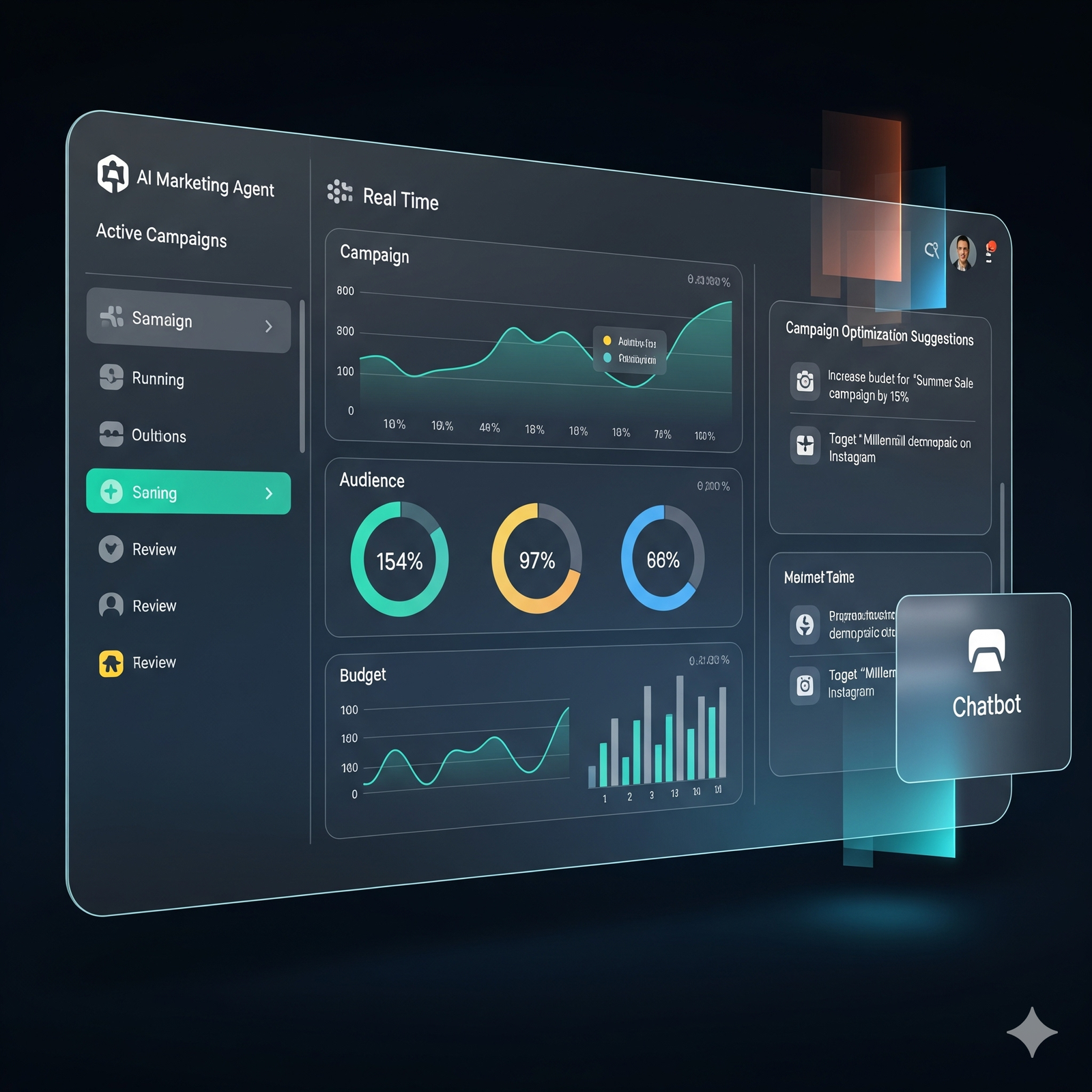
The excitement is palpable. Across boardrooms and marketing departments in the United States, the promise of Artificial Intelligence has ignited a new sense of possibility. The idea of an intelligent, autonomous AI agent—a digital team member that can qualify leads, personalize customer experiences, and analyze market trends 24/7—is incredibly compelling. It feels like we are on the verge of a new industrial revolution for business, one that promises unprecedented efficiency and growth.
However, as a marketing and technology strategist with two decades of experience, I have learned to approach these revolutionary moments with a healthy dose of pragmatic caution. I have witnessed the graveyard of expensive, ambitious technology projects that failed not because the technology itself was flawed, but because the implementation was misguided. The history of business is littered with stories of powerful new software that ended up as little more than glorified, unused icons on a desktop.
The implementation of an AI marketing agent is not a simple software installation; it is a fundamental shift in your business’s operating system. When done right, it can be the single most powerful catalyst for growth you have ever experienced. When done wrong, it can be a costly, frustrating, and demoralizing failure.
This guide is your strategic “pre-mortem.” It is a look into the future, designed to help you identify and avoid the most common, most dangerous, and most costly mistakes that businesses make when they embark on their AI journey. We will move beyond the hype and provide a clear, honest, and practical framework for ensuring your investment in this transformative technology delivers on its promise. This is not about the technology; it’s about the strategy, the process, and the people that make that technology successful.
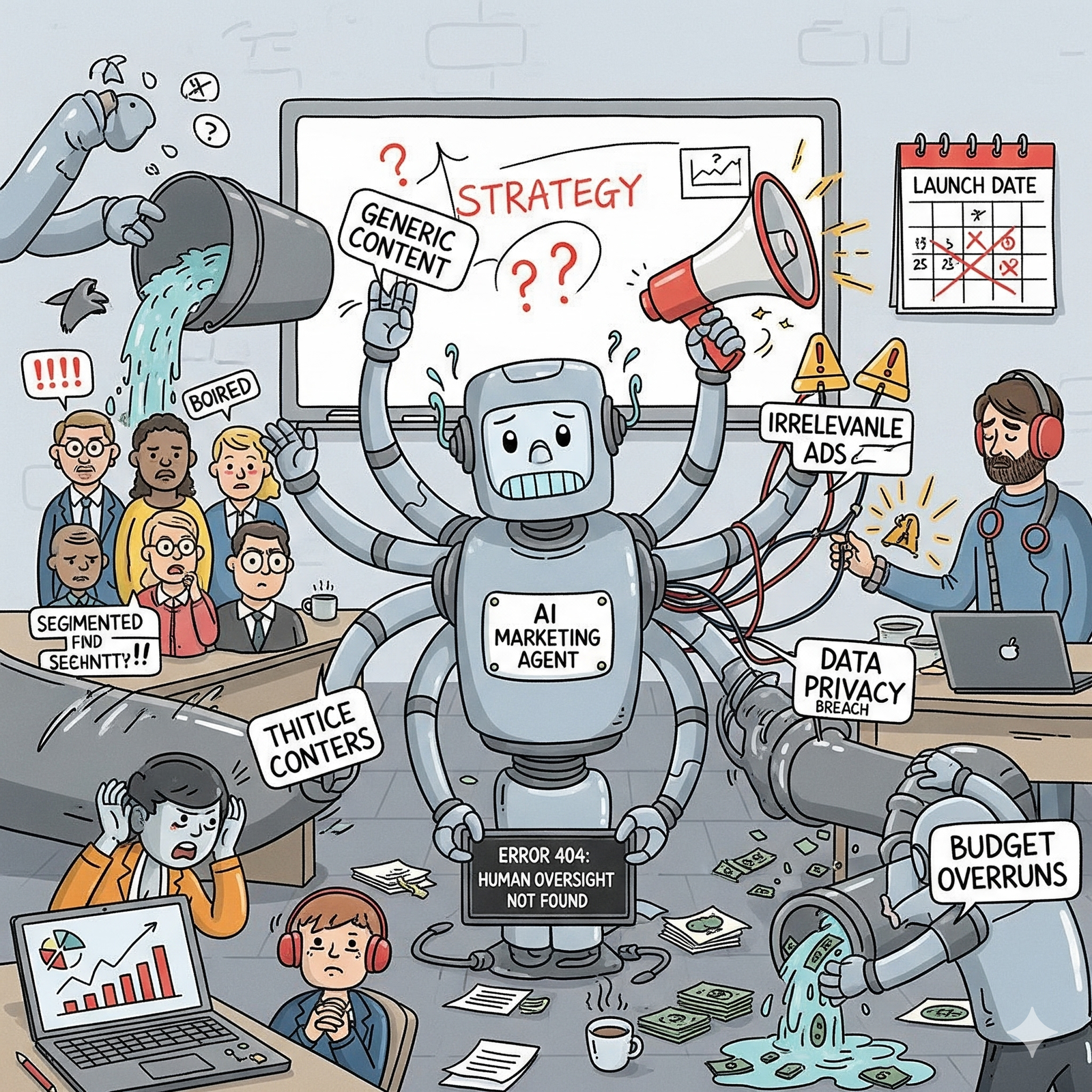
Mistake 1: starting with the technology, not the business problem
This is, without question, the single most common and most fatal error. The process often begins with a CEO or CMO returning from a conference, excited about a flashy AI demo they saw. The mandate comes down: “We need to be doing something with AI.” The team then goes out and buys a subscription to a sophisticated AI platform, without having a clear, specific, and measurable business problem that it is intended to solve.
Why this happens
This mistake is driven by the fear of missing out (FOMO) and a fascination with the technology itself. It’s a solution in search of a problem. The focus is on the shiny new tool, not on the business’s core strategic needs.
The disastrous consequences
The result is almost always a failed project. The team tries to apply the powerful new tool to a dozen different, ill-defined problems at once. The implementation loses focus. The results are vague and impossible to measure. After six months of high costs and minimal impact, the leadership team concludes that “AI doesn’t work for our business,” and the expensive software is abandoned. The real tragedy is that the technology likely could have worked, if it had been applied correctly.
The solution: a goal-first, technology-second approach
A successful implementation always begins with a single, clear question: What is the most significant bottleneck or the single greatest opportunity for growth in our business right now?
- Be ruthlessly specific. Don’t start with a vague goal like “we want more leads.” Start with a specific, measurable problem: “Our sales team is spending 60% of their time on manually qualifying low-quality leads, which is a massive drain on resources,” or “Our customer churn rate in the first 90 days is unacceptably high.”
- Define a clear KPI. Translate that problem into a Key Performance Indicator (KPI) that you want to move. For example: “Our goal is to reduce the time our sales team spends on initial lead qualification by 50%,” or “Our goal is to reduce 90-day customer churn by 15%.”
- Then, and only then, look for the tool. With this clear, specific goal in mind, you can now evaluate AI agent platforms based on a single criterion: which one is best-in-class at solving this specific problem? This goal-first approach ensures that your investment is targeted, measurable, and directly aligned with a tangible business outcome.
Mistake 2: ignoring the foundational importance of data quality and integration
An AI agent is not a magical being; it is a data-driven machine. Its intelligence is a direct reflection of the quality and accessibility of the data you feed it. Many businesses rush to implement an AI on top of a chaotic and siloed data infrastructure, which is like trying to build a skyscraper on a foundation of quicksand.
Why this happens
Data is often messy, and the work of cleaning and integrating it is unglamorous and difficult. It’s far more exciting to jump straight to the “cool” AI tool than to do the foundational “plumbing” work. Many businesses simply underestimate how much the principle of “garbage in, garbage out” applies to artificial intelligence.
The disastrous consequences
A poorly-fed AI will make poor decisions. If your CRM data is incomplete, your website analytics are not properly configured, and your customer support data lives in a separate, disconnected system, the AI agent will be operating with one hand tied behind its back.
- Flawed personalization: The agent might try to personalize an experience based on incomplete or incorrect data, leading to awkward or irrelevant conversations that damage the customer experience.
- Inaccurate predictions: A predictive lead scoring model built on messy, inconsistent sales data will be wildly inaccurate, causing your sales team to waste time on the wrong leads and ignore the right ones.
- Failed implementation: The project will get bogged down in technical hurdles as the team tries to connect the AI to a chaotic mess of disconnected systems.
The solution: conduct a data audit before you begin
Before you even sign a contract for an AI platform, you must conduct an honest and thorough audit of your data ecosystem.
- Inventory your data sources: Map out every system that holds valuable customer data: your CRM, your e-commerce platform, your marketing automation tool, your website analytics, your customer support desk.
- Assess data quality: How clean and consistent is the data in each of these systems?
- Plan for integration: Identify the key data points that need to flow between these systems to give your AI agent a unified, 360-degree view of the customer. A critical part of your implementation plan must be the project of breaking down these data silos, either through native integrations, middleware like Zapier, or a more sophisticated Customer Data Platform (CDP).
Mistake 3: underestimating the critical role of the “human-in-the-loop”
One of the biggest and most dangerous myths about AI is that it is a fully autonomous, “set it and forget it” technology. The allure is to hand over a complex business function entirely to the machine, hoping to eliminate the need for human oversight.
Why this happens
This is often driven by an unrealistic desire to completely eliminate headcount and human effort. It stems from viewing the AI as a replacement for human workers, rather than as a tool to augment them.
The disastrous consequences
An AI agent left completely to its own devices, without human training and oversight, can be a brand disaster waiting to happen.
- It can make embarrassing mistakes: An AI might misinterpret a customer’s sarcastic comment and respond with an inappropriately cheerful message.
- It can lack empathy: It might try to enforce a rigid policy in a situation that requires a nuanced, empathetic human touch.
- It can fail to adapt to new situations: If a new, unexpected problem arises that is not in its knowledge base, the agent will be helpless, creating a frustrating dead-end for the customer.
The solution: design a collaborative, human + AI workflow
The most successful AI implementations are built on a “human-in-the-loop” philosophy. The goal is not to remove the human, but to elevate them to a more strategic role.
- The human as the trainer: Your team’s role is to continuously train the AI. This involves regularly reviewing the AI agent’s conversations with customers, identifying where it succeeded and where it failed, and using this feedback to update its knowledge base and refine its conversational flows.
- The human as the exception handler: The AI agent should be programmed to handle the 80% of inquiries that are routine and predictable. But it must also be programmed to recognize when a situation is too complex, too emotional, or too unusual, and to seamlessly escalate that conversation to the right human expert.
- The human as the strategist: Your team provides the high-level strategic direction, the creative input, and the ethical oversight that the AI cannot.
The AI handles the scale and the speed; the human handles the strategy, the nuance, and the empathy. This collaborative “centaur” model is the key to a successful and sustainable implementation.
Mistake 4: launching a company-wide “big bang” instead of a focused pilot project
Driven by excitement, many companies try to implement a new AI solution across their entire organization at once. They want to launch a new chatbot, a predictive lead scoring model, and an AI-powered content strategy all in the same quarter.
Why this happens
This is often driven by top-down pressure to show rapid, large-scale transformation. It’s a desire to do everything at once.
The disastrous consequences
A “big bang” implementation is almost always a recipe for failure.
- It overwhelms your team: Your people are forced to learn and adapt to multiple new, complex systems and processes simultaneously, leading to confusion and resistance.
- The risk is too high: If the large-scale project fails or hits significant roadblocks, the financial and political cost can be huge, often poisoning the well for any future AI initiatives.
- It’s impossible to measure success: With so many variables changing at once, it’s nearly impossible to isolate which part of the new strategy is working and which isn’t.
The solution: the power of the small, winnable pilot project
The smartest approach is to think like a scientist: start with a small, controlled experiment.
- Be ruthlessly specific: Choose one specific, measurable use case from your primary business objective. For example: “We will implement an AI chatbot on our three highest-traffic service pages with the single goal of reducing the number of support tickets related to ‘password resets’ by 70% in 90 days.”
- Keep the team small and agile: Assign a small “tiger team” to own the pilot.
- Measure obsessively: Track the KPIs for the pilot religiously.
- The outcome: A successful pilot project provides undeniable, data-backed proof of the technology’s value. This makes it infinitely easier to get the buy-in and the budget for the next, more ambitious phase of the rollout. It is a low-risk, high-reward strategy for building momentum and ensuring long-term success.
The new blueprint for success: from technology to transformation
The journey to successfully integrating AI into your marketing is not fundamentally a technological one; it is a strategic and cultural one. The common mistakes we’ve explored are not failures of software; they are failures of strategy, planning, and process.
The old model of simply buying a tool and hoping for the best is obsolete. The new model requires a more thoughtful, holistic approach. It begins with a deep and honest assessment of your core business challenges. It is built on a foundation of clean, integrated data. It is executed through a collaborative partnership between intelligent machines and empowered human experts. And it is scaled through a series of carefully planned, measurable pilot projects.
By avoiding these common pitfalls, you are doing more than just implementing a new piece of software. You are building a new capability within your organization. You are creating a smarter, faster, and more customer-centric marketing engine that is not just prepared for the future, but is actively designing it. This is not just about technology; it is about transformation.
Leave a Reply