
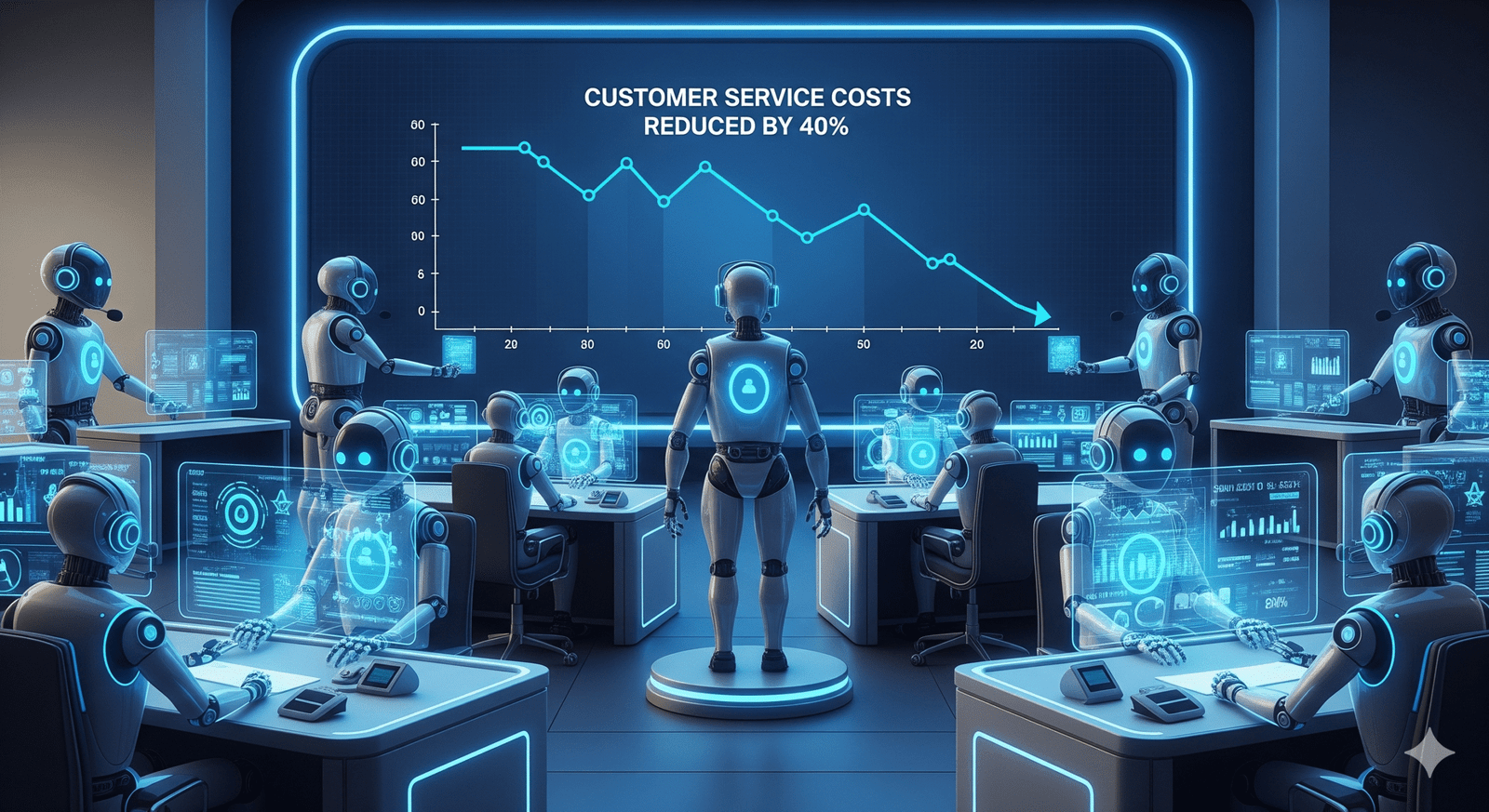
In the intricate machinery of any modern business, the customer service department often plays a dual role. It is, on one hand, the beating heart of the customer relationship—the human voice of the brand, the frontline problem-solvers, the builders of loyalty. On the other hand, for the C-suite and the finance department, it is often viewed as a massive, unavoidable cost center. It’s a world of ringing phones, escalating ticket counts, and a constant, resource-intensive battle to keep customers happy.
For decades, business leaders have been caught in a frustrating dilemma: how do you reduce the significant operational costs of customer service without sacrificing the quality of the experience? The traditional levers have been blunt instruments. Cutting headcount leads to longer wait times and agent burnout. Outsourcing to cheaper, offshore call centers often results in a drop in quality and customer satisfaction. It has felt like a zero-sum game where you either had to choose between a happy budget or happy customers.
As a media and marketing strategist who has spent two decades helping companies navigate the intersection of technology and customer experience, I am here to tell you that this dilemma is now obsolete. The rise of intelligent, conversational Artificial Intelligence has created a new paradigm, a third option that allows you to achieve both goals simultaneously. We are entering the era of the AI Agent.
This is not a guide about the simple, rule-based chatbots of the past that frustrated customers more than they helped. This is a strategic briefing for business leaders on how modern, truly intelligent AI agents can be deployed to not only dramatically reduce your customer service costs, but to simultaneously improve the speed, efficiency, and overall quality of your customer experience. We will deconstruct the true costs of a traditional service model and provide a clear, practical roadmap for how AI can transform your biggest cost center into an intelligent, efficient, and value-creating engine for your business.

The anatomy of a cost center: a forensic look at traditional customer service expenses
To understand how to save money, we must first understand exactly where the money is being spent. The budget for a traditional, human-powered customer service department is far more than just salaries.
The primary cost: the fully-loaded expense of human agents
The most significant line item is, of course, personnel. But the true cost of a human agent is not just their hourly wage or annual salary. The “fully-loaded” cost includes a host of other expenses:
- Benefits and taxes: Health insurance, retirement contributions, payroll taxes.
- Recruitment and hiring: The cost of advertising for a position, interviewing candidates, and background checks.
- Training and onboarding: A new agent can take weeks, or even months, to become fully proficient. During this time, they are a significant cost with limited productivity.
- Technology and infrastructure: The cost of their computer, headset, software licenses (for CRM, ticketing systems, etc.), and the physical office space they occupy.
When all these factors are combined, the true cost of a single human agent can be 1.5x to 2x their base salary.
The hidden cost of inefficiency: the tyranny of repetitive inquiries
This is the silent killer of productivity and the primary driver of unnecessary costs. Extensive research across industries shows that a staggering 60-80% of all incoming customer service inquiries are simple, repetitive, and low-complexity questions. Think about your own business. How many times a day do your agents answer questions like:
- “Where is my order?” (WISMO)
- “What is your return policy?”
- “I forgot my password, how do I reset it?”
- “What are your opening hours?”
- “Do you ship to my location?”
Each time a highly-trained, expensive human agent spends five minutes answering one of these simple questions, the business is effectively burning money. If 70% of your agents’ time is spent on these routine tasks, it means that 70% of your entire customer service personnel budget is being allocated to work that does not require human creativity, empathy, or complex problem-solving skills.
The financial drain of high agent turnover
Customer service is a notoriously high-stress job, leading to one of the highest employee turnover rates of any industry. This constant churn is a massive financial drain. Every time an agent leaves, the business incurs:
- The cost of recruiting and hiring their replacement.
- The cost of training the new agent.
- The cost of the lost productivity during the several months it takes for the new agent to reach the efficiency of their experienced predecessor.
- The “soft cost” of the negative impact on team morale and the potential for a drop in service quality during the transition.
The 24/7 problem: the prohibitive cost of after-hours support
In our always-on, global economy, customers increasingly expect support outside of traditional 9-to-5 business hours. However, staffing a human call center around the clock, on weekends, and during holidays is prohibitively expensive for all but the largest corporations, requiring multiple shifts and overtime pay. This leaves most businesses with a significant gap in their customer service, leading to frustrated customers and lost opportunities.
What is an intelligent AI agent (and how is it different from a “dumb” chatbot)?
To understand how AI solves these problems, we must first distinguish the modern AI service agent from its frustrating, primitive ancestor: the rule-based chatbot.
The frustrating limitations of the old, rule-based bots
We have all experienced the pain of interacting with a “dumb” bot. These were simple decision trees, like a visual phone menu. They could only respond to pre-programmed keywords or button clicks. If your question deviated even slightly from their rigid script, they would respond with the infamous, “I’m sorry, I don’t understand that.” They were a barrier, a frustration, not a solution.
The three pillars of a modern, intelligent service agent
A true AI agent is a completely different technology, built on a foundation of three core capabilities that allow it to understand, think, and act.
- Conversational understanding (Natural Language Processing – NLP): A modern agent can understand the intent behind a user’s question, regardless of how it’s phrased. It understands that “my order hasn’t arrived,” “where’s my stuff?”, and “what’s the status of order #12345?” are all asking the same fundamental “Where Is My Order?” (WISMO) question. It can handle typos, slang, and complex sentences.
- System integration (The “Hands and Eyes”): This is the most critical difference. An AI agent is not an isolated FAQ document. It is connected directly, via APIs, to your core business systems. It can access your order management system, your CRM, your product database, and your central knowledge base. It can see the information a human agent would see.
- Autonomous action (The “Brain”): Because it can understand the question and access the data, the agent can perform tasks autonomously. It doesn’t just tell the user how to reset their password; it can initiate the password reset process. It doesn’t just tell you the return policy; it can start the return authorization for the user.
In short, a rule-based bot is a script. An AI agent is a system.
The AI-powered cost reduction strategy: a practical implementation guide
Now, let’s connect these capabilities directly to the cost centers we identified earlier. Here is a practical, step-by-step strategy for how an AI agent can systematically reduce your customer service costs.
Strategy 1: automate the high-volume, low-complexity inquiries (The 80/20 Rule)
The primary strategy is to apply the 80/20 rule: let the AI agent handle the 80% of inquiries that are simple and repetitive, so your human team can focus on the 20% that are complex and require a human touch.
- The AI as the first point of contact: The AI agent should be configured to be the “digital front door” for all incoming customer inquiries, whether via web chat, Facebook Messenger, or even email.
-
Automated resolution of the “Top 10” questions: The agent should be trained and integrated to autonomously resolve your most frequent inquiries.
- WISMO (“Where Is My Order?”): The agent asks for the user’s name and order number. It then performs a real-time lookup in your shipping or e-commerce platform and provides the user with the exact, up-to-the-minute tracking status and a direct link to the carrier’s tracking page. Human effort saved: 100%.
- Password resets: The agent can verify the user’s identity through their email address and automatically trigger the secure password reset link to be sent. Human effort saved: 100%.
- Return policy and initiation: The agent can provide a link to the return policy and, for eligible orders, can present the user with a simple form to initiate the return process directly within the chat. Human effort saved: 100%.
- The immediate financial impact: Let’s imagine a team of 10 human agents. If 70% of their time was previously spent on these simple, now-automated tasks, you haven’t just reduced costs. You have effectively tripled the capacity of your human team to handle complex issues, all without hiring a single new person. The ROI is immediate and massive.
Strategy 2: reduce agent training time and improve service consistency
High turnover and long training periods are a major cost. An AI agent can dramatically reduce both.
- The AI as a “co-pilot” for human agents: The AI is not just for customers; it’s a powerful tool for your own team. When a human agent is handling a complex chat or call, the AI can work in the background. It listens to the customer’s question in real-time and automatically surfaces the relevant knowledge base articles, policy documents, and step-by-step guides on the agent’s screen.
-
The financial impact:
- Reduced training time: This “co-pilot” dramatically reduces the time it takes for a new agent to become fully proficient. They no longer need to memorize every single policy; they have an intelligent assistant guiding them. This can cut onboarding time by 50% or more.
- Increased consistency: The AI ensures that every agent is providing the same, accurate, up-to-date information to customers, improving the overall quality and consistency of your service.
Strategy 3: providing scalable and highly cost-effective 24/7 support
An AI agent never sleeps, never takes a vacation, and never asks for overtime pay.
- The “after-hours” digital team: The AI agent becomes your entire after-hours, weekend, and holiday support team. It can fully resolve the majority of simple issues instantly, at any time of day or night. For more complex issues that require a human, it can create a detailed support ticket with the full conversation history, so that when your human team arrives in the morning, they have a perfectly prioritized and context-rich queue waiting for them.
- The financial impact: This allows your business to offer true 24/7 support—a major competitive advantage—without the enormous and often prohibitive cost of staffing a human call center around the clock. You are providing a better service to your customers for a fraction of the cost.
The new service paradigm: when efficiency meets satisfaction
The most profound impact of implementing an intelligent AI agent strategy is the redefinition of the role of your human customer service team. The goal is not to eliminate them, but to elevate them.
In the old model, your best, most empathetic, and most experienced agents were bogged down, spending most of their day as human FAQ machines. It was a recipe for boredom, burnout, and high turnover.
In the new, AI-augmented model, the entire paradigm shifts. Your AI agents become the undisputed masters of high-volume, transactional, and informational inquiries. They handle the routine with a level of speed and efficiency that no human can match.
This liberates your human agents to become what they were always meant to be: high-value specialists in complex, emotional, and relationship-building inquiries. They are no longer just answering simple questions; they are handling the most difficult cases, calming the most frustrated customers, and turning potential brand detractors into loyal advocates. Their job becomes more challenging, more engaging, and infinitely more valuable to the company.
The result is a system that is a win-win-win:
- The customer wins: They get instant, 24/7 answers to their simple questions, and when they have a complex problem, they are quickly connected to a highly-skilled human who has the time and focus to truly help them.
- The employee wins: Their job satisfaction increases as they are freed from the mundane and empowered to use their uniquely human skills of empathy and complex problem-solving.
- The business wins: It achieves a dramatic reduction in operational costs, a significant increase in efficiency, and a measurable improvement in key metrics like Customer Satisfaction (CSAT) and Net Promoter Score (NPS).
This is not about replacing your team; it is about building a better, more intelligent, and more human-centric one.
Leave a Reply