
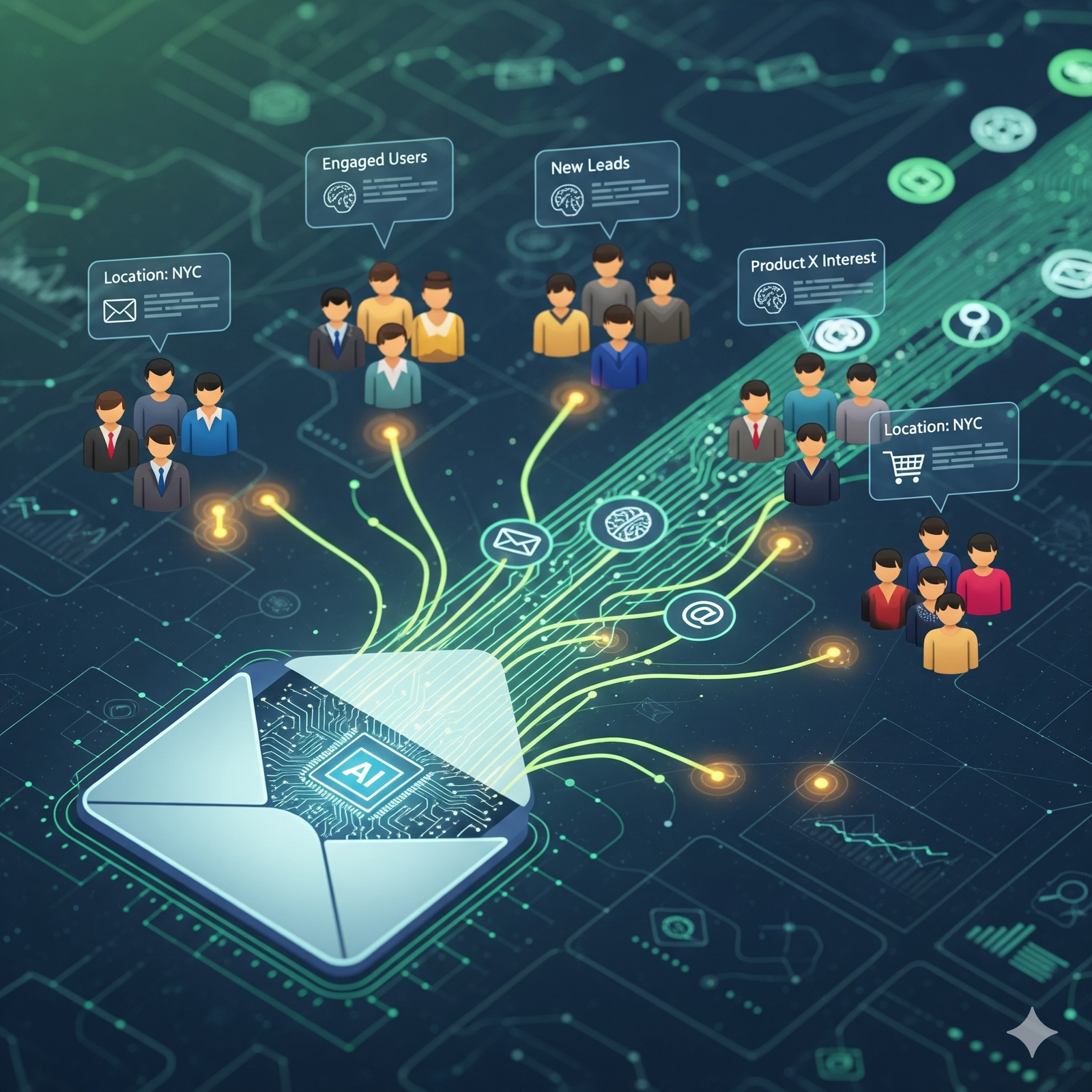
There is a love-hate relationship at the heart of all digital marketing, and it resides in our inboxes. Email is the workhorse, the reliable backbone of our communication—the channel that consistently delivers the highest return on investment. Yet, for the customer, it is often a source of relentless noise. Their inbox is a battlefield, a chaotic arena where hundreds of brands are locked in a desperate, daily struggle for a few seconds of their attention.
As marketers, we’ve spent years trying to win this battle with the tools of traditional email marketing. We’ve built intricate, rule-based automation workflows. We’ve meticulously crafted what we believed were clever “segments,” grouping our audience into broad buckets like “new subscribers” or “past purchasers.” We celebrated when we moved from sending one generic email blast to sending five slightly different generic email blasts. We were doing the best we could with the tools we had.
As a marketing strategist who has witnessed the evolution of this channel for two decades, from the first simple newsletters to today’s complex automation platforms, I can tell you that we are at the beginning of a new, profoundly more intelligent era. The era of manual segmentation and rigid, pre-programmed “drip campaigns” is over. The future of the inbox is being reshaped by the power of Artificial Intelligence.
This is not a guide about a few new features in your favorite email platform. It is a strategic briefing on a fundamental paradigm shift. We will explore how AI is moving beyond simple automation to create a new discipline of predictive, hyper-personalized, and truly one-to-one communication at a scale that was previously unimaginable. We will deconstruct the limitations of the old way and provide a clear, practical framework for how you can use AI-driven campaigns and segmentation to not just get your emails opened, but to build deeper customer relationships and supercharge your revenue.
A look back: the power and the painful limitations of traditional email marketing
To understand the magnitude of the AI-powered shift, we must first be honest about the glass ceiling we have hit with our traditional email marketing efforts.
The rise of the email blast and the dawn of manual segmentation
The first wave of email marketing platforms, like Mailchimp, was a revolution. It democratized direct marketing, allowing any business to communicate directly with its audience at a very low cost. As our lists grew, we knew we couldn’t send the same message to everyone. This led to the rise of segmentation.
The process was manual but logical. We would create static lists based on simple, historical data points:
- Demographic segments: Based on age, gender, or location.
- Purchase history segments: “Customers who bought Product A,” “VIP customers who have spent over $500.”
- Engagement segments: “Subscribers who have opened an email in the last 30 days.”
This was a massive leap forward from the one-size-fits-all email blast. It allowed us to create more relevant communication, and it worked. But this model has deep, inherent limitations.
The limitations of a rigid, rule-based world
The traditional email marketing and automation model is fundamentally reactive and rule-based.
- Segments are static and backward-looking: The segments are based on what a customer did in the past. A customer who bought a pair of hiking boots a year ago is forever locked in the “hiker” segment, even if their current browsing behavior clearly indicates they are now shopping for baby products. The system has no ability to adapt to a customer’s evolving needs in real-time.
- Automation workflows are brittle and impersonal: The classic “drip campaign” is a perfect example. We create a rigid, linear sequence: “IF a user signs up, THEN send Welcome Email A. THEN wait 3 days. THEN send Educational Email B.” Every single user is forced down the exact same pre-determined path, regardless of how they interact with the emails. It’s a monologue, not a dialogue.
- The content remains generic: Because even the most detailed manual segments still contain thousands of diverse individuals, the content we send to them must, by necessity, be relatively generic. We are still communicating on a “one-to-many” basis, not a true “one-to-one” level.
- The guesswork of timing: We rely on general “best practices” to schedule our campaigns, like sending an email at “10 AM on a Tuesday.” This ignores the fact that every individual subscriber has their own unique habits and rhythms.
The AI revolution: a new, intelligent brain for your email marketing platform
AI is not just a feature; it is a new operating system for email marketing. It transforms the entire process from a reactive, rule-based system into a proactive, predictive, and personalized one.
From static lists to dynamic, predictive segmentation
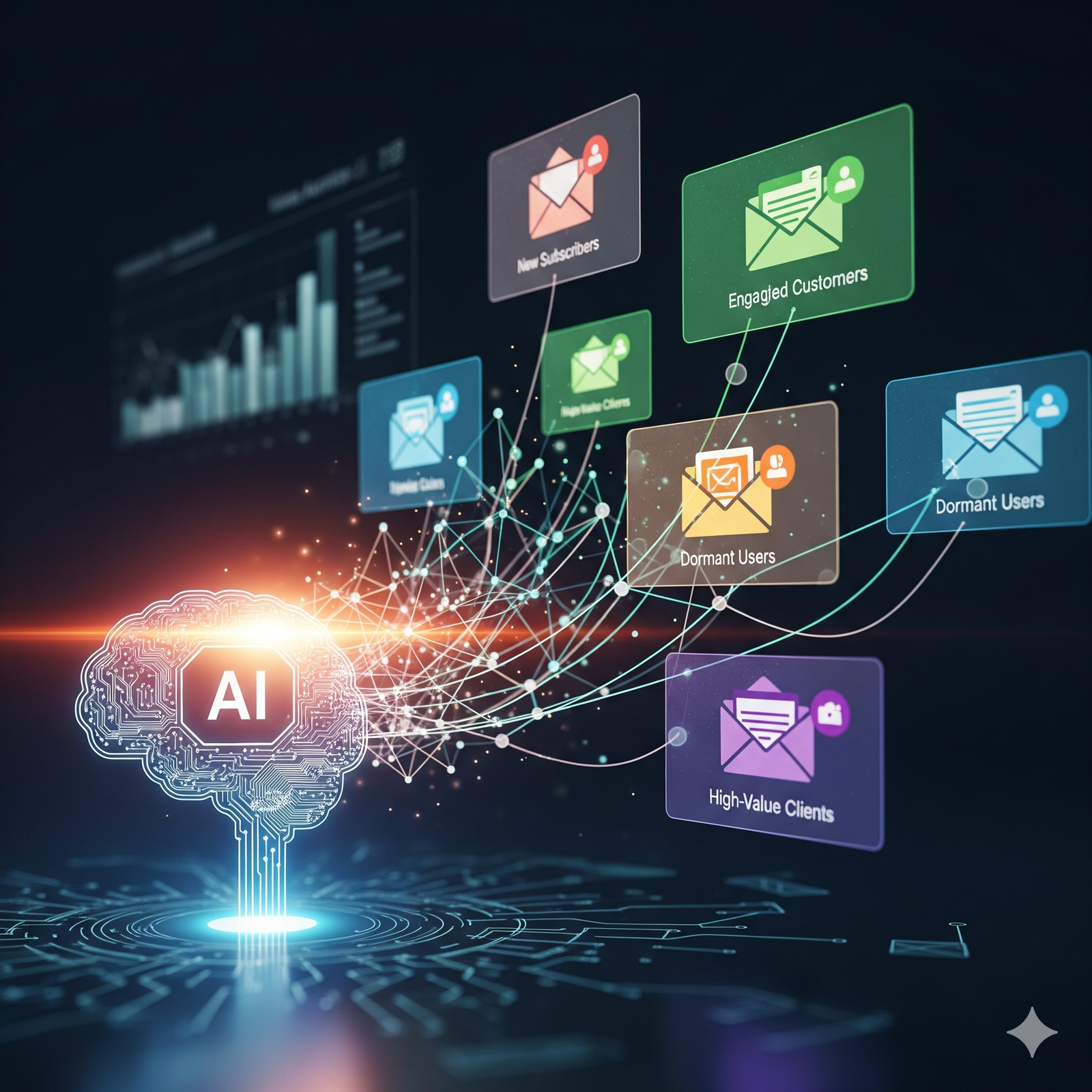
This is the most profound change. AI allows us to move beyond segmenting based on what customers did, and start segmenting them based on what they are likely to do next.
- How it works: A machine learning model analyzes the unified profile of each customer—their complete purchase history, their real-time website browsing behavior, their previous email engagement, and their customer support interactions. By comparing this data to the patterns of thousands of other customers, the AI can build powerful predictive segments.
-
Examples of intelligent, predictive segments:
- “High Propensity to Buy” Segment: The AI identifies a group of users who, based on their recent browsing behavior (e.g., viewing a product multiple times, looking at the sizing guide), are exhibiting the classic signs of being on the verge of a purchase.
- “At-Risk of Churning” Segment: The AI identifies long-time customers who have become disengaged—they haven’t opened an email in 60 days, and they haven’t visited the website.
- “Next Logical Product” Segment: For a customer who just bought a new digital camera, the AI predicts that their next logical purchase will be a memory card or a camera bag.
- “Category Interest” Segment: The AI identifies users who have repeatedly browsed a specific product category (e.g., “women’s trail running shoes”) but have never made a purchase. These segments are dynamic, updating in real-time as a customer’s behavior changes.
From pre-written drafts to generative, personalized content
Generative AI allows for a level of content personalization that was previously impossible.
- AI-powered subject line optimization: Instead of you manually A/B testing two subject lines, an AI can generate dozens of variations. Even more powerfully, it can use predictive analytics to choose the specific subject line that is most likely to resonate with and be opened by each individual subscriber based on their past engagement history.
- Dynamic content blocks: The email template can remain the same, but specific content blocks within it can be dynamically populated by a generative AI in real-time. The agent can insert the three specific products the user was just browsing, or pull in the headline of a blog post related to their predicted interests.
From blast-off to one-to-one send time optimization
The AI analyzes the individual open and click history for every single subscriber on your list. It learns their unique digital rhythm. It knows that Jane from California almost always checks her promotional emails on her lunch break at around 12:30 PM Pacific Time, while David in New York is a night owl who is most active around 10 PM Eastern Time. When you schedule a campaign, you no longer pick a single time. You simply hit “send,” and the AI engine automatically delivers the email to Jane at 12:30 PM her time, and to David at 10 PM his time, ensuring the message arrives at the exact moment it is most likely to be seen at the top of their inbox.
The AI-powered email campaign in action: a step-by-step transformation
Let’s look at how this new technology transforms some of the most common and important email marketing campaigns.
The abandoned cart recovery flow 2.0
- The traditional way: A single, generic “You left something behind!” email is sent to everyone 24 hours after they abandon their cart. The success rate is typically low.
-
The AI-powered way: The AI agent triggers a multi-step, intelligent, and personalized recovery sequence.
- Step 1 (1 hour after abandonment): An initial, gentle reminder email is sent, simply showing the product and a “Complete Your Purchase” button.
- Step 2 (24 hours later, if no action): The AI now makes a strategic decision. For a high-value cart, it might trigger a second email that includes a powerful customer testimonial or a 5-star review for the specific product in the cart, designed to build confidence and overcome hesitation.
- Step 3 (3 days later, if still no action): The AI makes another decision. If this is a new, price-sensitive customer (based on their browsing behavior), it might trigger a final email with a small, single-use discount code or a free shipping offer. If it’s a known, high-LTV customer, it might instead trigger a task for a human customer service agent to make a personal follow-up call.
The proactive “win-back” campaign 2.0
- The traditional way: Every 90 days, a generic “We miss you! Here’s 15% off” email is blasted out to every subscriber who hasn’t made a purchase in that period.
- The AI-powered way: The campaign is triggered not by a static time period, but by the AI’s predictive churn model. The agent identifies a high-value customer who is showing signs of disengagement. The email content is then hyper-personalized. Instead of a generic coupon, the email showcases “New Arrivals in [Favorite Category],” the exact product category the customer used to purchase from most frequently. The subject line can be personalized: “Jane, we’ve got some new [Favorite Product Type] we think you’ll love.” This targeted, relevant approach is dramatically more effective at re-engaging a lapsed customer.
The intelligent cross-sell and upsell campaign 2.0
- The traditional way: A customer buys a product, and they are added to a generic “post-purchase” drip campaign that promotes the company’s general bestsellers.
-
The AI-powered way: The agent uses a “next best offer” model.
- Intelligent Cross-Sell: A customer buys a new high-end laptop. The AI agent knows from analyzing thousands of past transactions that the most common follow-up purchases are a specific brand of wireless mouse and a particular laptop sleeve. A week after the laptop is delivered, the agent sends a helpful email: “Three accessories to get the most out of your new laptop,” featuring those specific, highly relevant products.
- Predictive Upsell: The AI identifies a segment of customers who have consistently purchased mid-range products but have recently been browsing the high-end, premium collection. The agent can then send this specific segment an exclusive offer or an invitation to a virtual event showcasing the benefits of the premium line, nurturing them towards a higher-value purchase.
The new strategist’s role: conducting the AI email orchestra
The rise of the AI email marketing agent does not mean the email marketer’s job is over. It means the frustrating, tedious, and manual parts of the job are over. The role is elevated from a “campaign operator” to a “customer journey architect.”
Your new role is not to spend your days building complex, 50-step workflows in your automation tool. Your new role is to:
- Define the strategic goals: You tell the AI what to achieve (e.g., “reduce churn by 10%,” “increase repeat purchase rate by 15%”).
- Be the creative director: You provide the brand voice, the storytelling, the compelling imagery, and the core value propositions that the AI will use to assemble its personalized messages.
- Be the human expert: You are the final checkpoint for quality and empathy, ensuring that the automated system is always creating a positive and helpful customer experience.
- Be the analyst: You interpret the deep insights that the AI uncovers about your customers’ behavior and use that intelligence to inform your broader marketing and even your product strategy.
The AI is the orchestra, capable of playing a million different notes at once. You are the conductor, guiding the performance with a clear, strategic vision to create a beautiful symphony of customer communication. The result is a marketing function that is not just more efficient, but more intelligent, more empathetic, and profoundly more effective.
Leave a Reply