
For the past few years, the marketing world has been electrified by the arrival of Artificial Intelligence. We’ve witnessed the rise of AI-powered tools that can write blog posts, generate stunning images, and analyze complex data sets in the blink of an eye. This has been Phase One of the AI revolution: the era of the intelligent tool. We learned to wield these new, powerful instruments—the AI writing assistant, the image generator, the data analysis platform—to become more efficient and creative. It has been a transformative period, but it is merely the opening act.
We are now entering Phase Two. This is the shift from tools we operate to agents we direct. It’s the difference between using a sophisticated power drill to build a house yourself, and dispatching a team of autonomous robotic builders with a single command: “Build me a house according to these blueprints.” This is the dawn of the AI Marketing Agent, and it represents a paradigm shift so fundamental that it will redefine not just our marketing tactics, but the very structure of our marketing departments and the nature of our work.
As a media and marketing strategist who has spent two decades tracking the evolution of digital technology, I can tell you that this is not a distant, science-fiction concept. The first generation of AI agents is already here, and their capabilities are growing exponentially. Understanding what they are and how they work is no longer an intellectual curiosity; it is a strategic necessity for any business leader or marketer who wants to remain competitive in the coming decade.
This guide is a deep dive into this new frontier. We will demystify what an AI Marketing Agent truly is, explore how it differs from the AI tools we’ve grown accustomed to, and provide a practical look at how these autonomous systems are already beginning to revolutionize every facet of digital marketing, from SEO and content creation to paid media and social media management.
From passive tools to proactive partners: defining the AI agent
To grasp the magnitude of this shift, we must first draw a clear distinction between an AI tool and an AI agent.
The limitations of our current AI tools
The generative AI platforms we use today, like ChatGPT, Claude, or Midjourney, are incredibly powerful but fundamentally passive. They are single-task executers.
- They require constant human prompting: A tool like ChatGPT waits for your command. You ask it to write a headline. It writes a headline. You ask it to write the first paragraph. It writes the first paragraph. You then have to ask it for the next step, and the next, and the next.
- They lack memory and long-term goals: Each interaction is largely discrete. The tool doesn’t have an overarching goal it is trying to achieve on its own.
- The human is the project manager: In this model, the human marketer is the strategic brain and the project manager. We break down a large goal (like “launch a content campaign”) into a series of small, sequential tasks that we then delegate to our AI tools one by one.
The three core components of a true AI agent
An AI agent, on the other hand, is a proactive, goal-oriented system designed to operate autonomously. It is defined by three core capabilities that set it apart from a simple tool:
- A goal-oriented mindset: You don’t give an agent a single, specific task. You give it a high-level goal. For example, the goal might be: “Increase organic search traffic for our new ‘QuantumLeap’ software product line by 20% in the next quarter.”
-
Autonomous planning and task execution: This is the revolutionary leap. Based on the high-level goal, the agent can independently devise a plan and break it down into a series of logical sub-tasks. For the goal above, the agent might autonomously create the following plan:
- Task 1: Perform a comprehensive keyword and topic cluster analysis for “QuantumLeap software.”
- Task 2: Conduct a content gap analysis against the top three competitors.
- Task 3: Generate a data-driven content brief for a pillar page titled “The Ultimate Guide to QuantumLeap Software.”
- Task 4: Generate a first draft of the pillar page content.
- Task 5: Identify five long-tail questions related to the topic and generate briefs for five supporting blog posts.
- Task 6: Draft the five blog posts.
- Task 7: Draft a series of social media posts for LinkedIn and Twitter to promote the new content.
- Task 8: Submit all drafted content for human review.
- Learning and adaptation: A true agent doesn’t just execute a plan blindly. It has a feedback loop. It can access real-time data, analyze the performance of its own actions, and then adapt its future plans based on what it has learned. If the agent observes that blog posts featuring a customer case study receive 50% more engagement than those that don’t, it will adapt its future content briefs to prioritize the inclusion of case studies.
An effective analogy is to think of your marketing team. A generative AI tool is like a brilliant but very literal junior copywriter who you have to give very specific, step-by-step instructions to. An AI marketing agent is like a motivated, data-driven marketing manager who you give a quarterly objective (a KPI) to, and who then comes back to you a week later with a completed plan and a series of drafted deliverables ready for your final approval.
The new marketing department: a look at specialized AI marketing agents in action
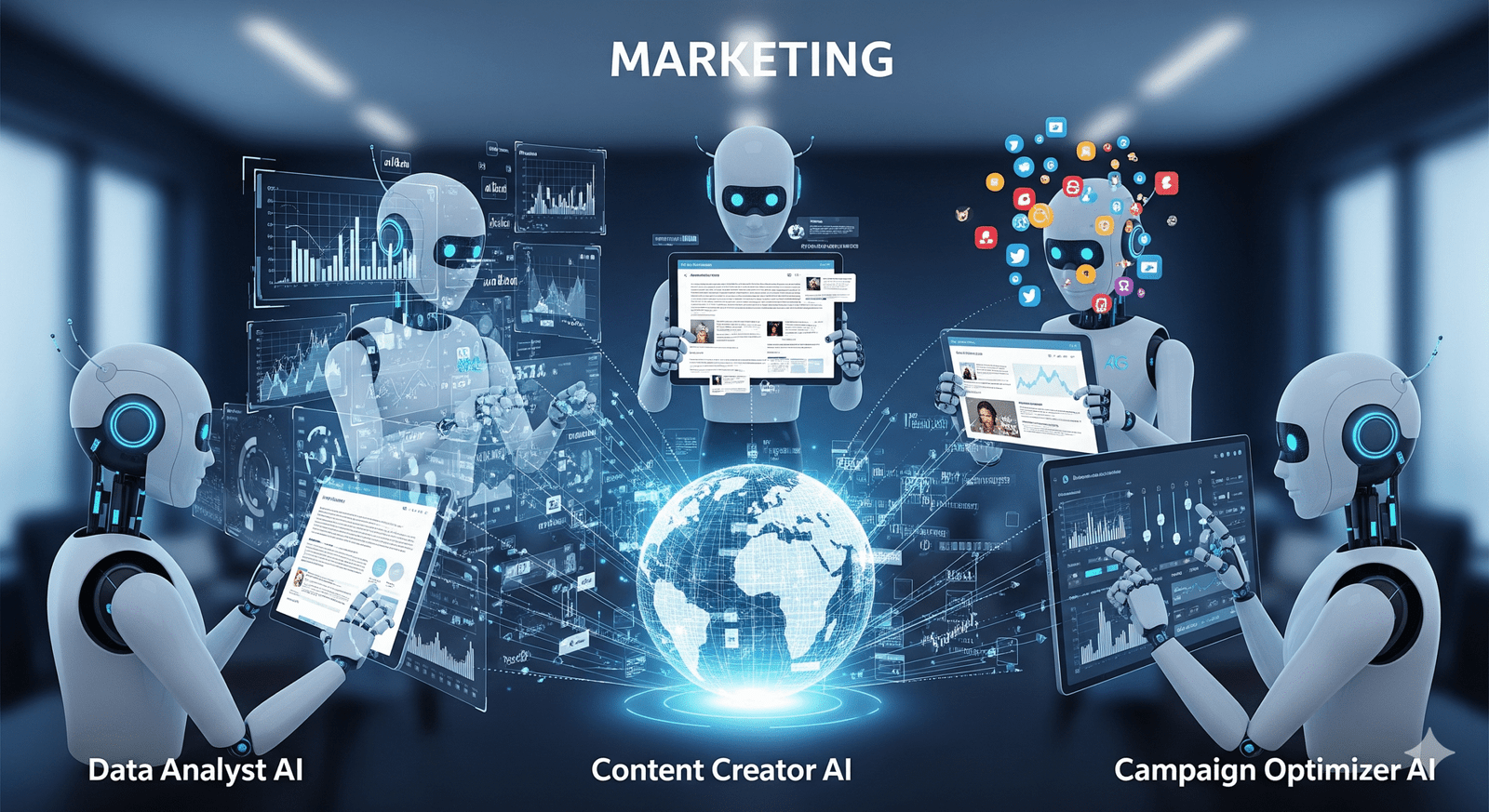
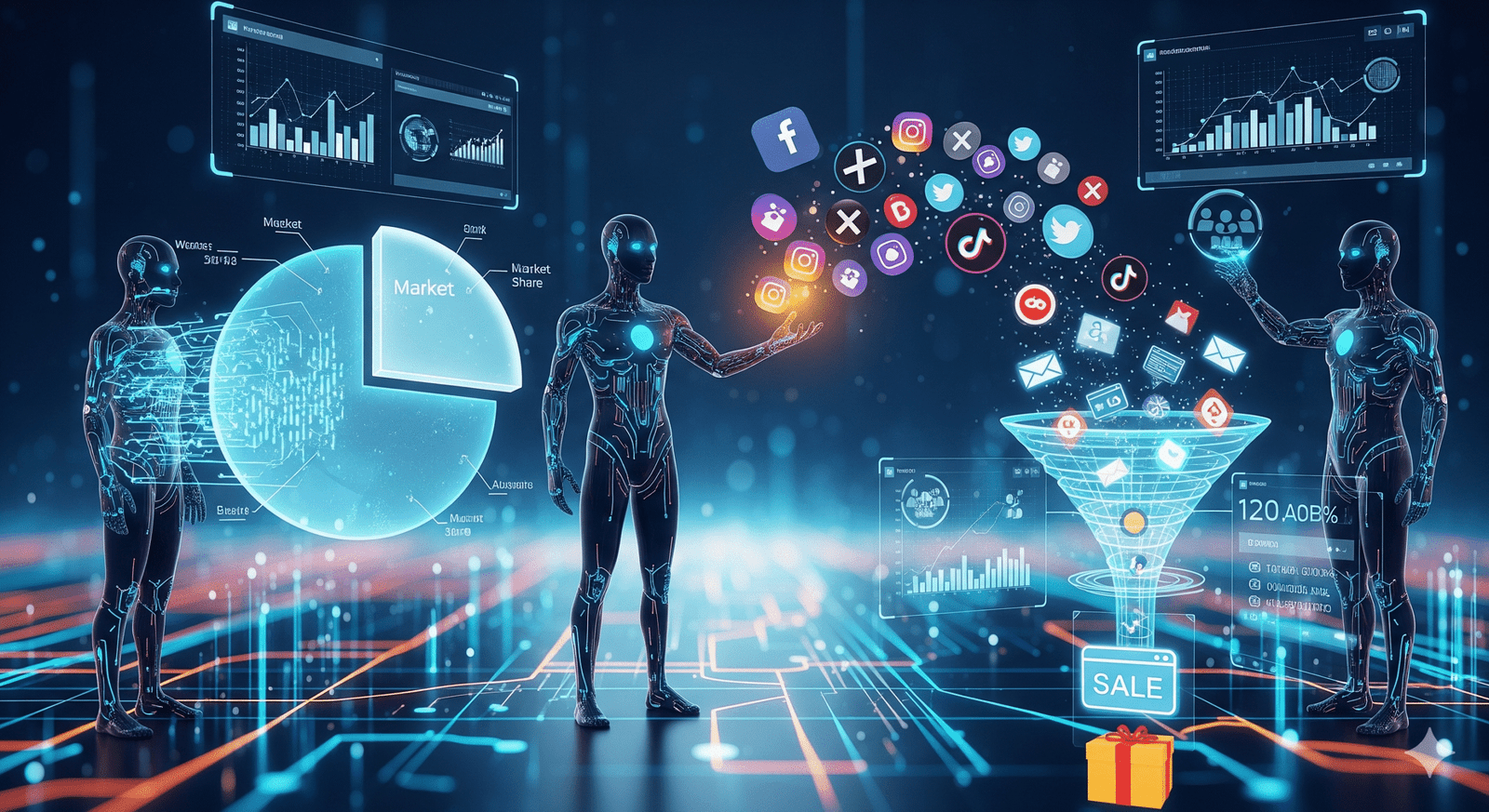
The future of the marketing department is not one big, monolithic “Marketing AI.” Instead, it will be a collaborative ecosystem of specialized agents, each an expert in its own domain, all working together towards the company’s high-level goals, and all orchestrated by a human marketing leader. Let’s imagine what this new, augmented team looks like.
The SEO strategist agent: your 24/7 market intelligence officer
This agent is the foundation of the entire digital marketing effort. Its primary goal is to achieve and maintain topical authority in the search engines.
- The goal you set: “Become the #1 most authoritative online resource for ‘sustainable packaging solutions’ in the North American market.”
-
Its autonomous actions:
- Continuous Monitoring: The SEO agent continuously monitors search trends using predictive analytics, scans industry news for new regulations, and watches competitor content launches in real-time.
- Opportunity Identification: It performs ongoing content gap analyses and identifies new, emerging “striking distance” keywords where a small effort could yield a big ranking improvement.
- Strategic Planning: Based on its analysis, it autonomously builds and refines a long-term content calendar, creating a strategic roadmap of pillar pages and cluster topics designed to systematically capture the entire topic.
- Proactive Technical Audits: It regularly crawls the company website to find technical SEO errors—broken links, slow pages, indexation issues—and can even be programmed to automatically create a ticket with a prioritized recommendation in the development team’s project management system (like Jira or Asana).
The content creator agent: your scalable content production engine
This agent works in tandem with the SEO strategist agent, taking its strategic plans and turning them into tangible assets.
- The goal you set: “Execute the content calendar provided by the SEO agent, producing four blog posts and one pillar page per month, ready for human editorial review.”
-
Its autonomous actions:
- Draft Generation: It takes the data-driven content briefs from the SEO agent and uses its generative capabilities to write well-structured, researched, and SEO-optimized first drafts of all the required articles.
- Multimodal Asset Creation: It doesn’t stop at text. It can generate relevant images, data visualizations, and infographics to accompany the articles. It can take the key points of a blog post and automatically generate a script for a short-form video or a presentation slide deck.
- Content Repurposing: When a new article is published, this agent can automatically generate a series of promotional posts tailored for different social media platforms—a professional, insightful post for LinkedIn, a short, punchy thread for Twitter, and a visually-driven summary for Instagram. It can also draft the announcement for the company’s email newsletter.
The paid media buyer agent: your hyper-efficient advertising manager
This agent’s goal is to maximize the return on ad spend (ROAS) with a level of speed and precision that is impossible for a human.
- The goal you set: “Generate 500 qualified leads for our upcoming webinar on ‘AI in Logistics’ with a maximum cost-per-acquisition (CPA) of $75.”
-
Its autonomous actions:
- Campaign Architecture: It designs the campaign structure across Google Ads and LinkedIn, based on the target audience defined in the company’s CRM.
- Creative Generation and Testing: It generates dozens of ad copy variations and pairs them with different images, creating a large-scale multivariate test.
- Real-Time Optimization: It uses a multi-armed bandit testing approach, automatically and continuously shifting the budget away from underperforming ad combinations and towards the winners in real-time. It monitors performance 24/7, making thousands of micro-adjustments to bids and budgets to maximize the number of leads while staying within the target CPA.
The social media manager agent: your brand’s vigilant digital ear
This agent acts as the first line of defense and engagement on social platforms.
- The goal you set: “Monitor brand mentions and increase our response rate to customer queries on Twitter by 50%.”
-
Its autonomous actions:
- Social Listening: The agent constantly monitors social media for mentions of the company’s brand name, products, and key executives.
- Sentiment Analysis: It uses NLP to analyze the sentiment of each mention. It can distinguish between a positive testimonial, a neutral question, and an urgent customer complaint.
- Triage and Response Drafting: It can automatically provide a standard answer to common questions. For urgent complaints, it can alert the human community manager and even provide a draft of an empathetic, helpful response for them to review, edit, and post.
The human in the loop: the new, elevated role of the marketing professional
This vision of an autonomous marketing department can seem intimidating. Does this mean there is no room left for human marketers? The answer is a definitive no. It means the role of the human marketer is becoming more important, more strategic, and ultimately, more creative than ever before.
From task executor to strategic orchestrator
The role of the human marketing leader shifts from being a manager of people who do tasks, to being a conductor of an orchestra of specialized AI agents. Your job is no longer to manually check the keyword rankings or approve every social media post. Your job is to set the high-level strategy, to define the goals, and to ensure that all the different agents are working in harmony to achieve the company’s business objectives. You are the strategist, the creative director, and the final human checkpoint for quality and brand alignment.
The essential skills for the future of marketing
In this new era, the most valuable skills are not the technical ability to operate a specific tool. They are the uniquely human capabilities that an AI cannot replicate:
- Strategic thinking: The ability to see the big picture, understand the competitive landscape, and set clear, ambitious goals.
- Creativity and innovation: The ability to come up with a truly novel campaign idea, a compelling brand story, or a unique value proposition that will cut through the noise.
- Empathy and emotional intelligence: The ability to deeply understand the human customer on the other end of the screen—their fears, their needs, their motivations—and to ensure that all automated communication is still fundamentally human and empathetic.
- Ethical judgment: The ability to act as the conscience of the system, ensuring that the power of AI is used responsibly, transparently, and for the benefit of the customer.
The dawn of the autonomous marketing era: a strategic outlook
The shift from AI tools to AI agents is not an incremental update; it is a tectonic shift in the landscape of marketing. It represents the transition from human-assisted marketing to human-directed, autonomous marketing. This new paradigm offers a level of scale, speed, and intelligence that will create a significant divide between the businesses that embrace it and those that do not.
The benefits are clear and profound:
- Exponential Scale: The ability to execute a month’s worth of research, content drafting, and campaign optimization in a matter of days.
- Proactive Strategy: The power to act on data-driven insights and emerging trends before they even appear in a traditional analytics report.
- The Liberation of Human Potential: The freedom for your most talented, creative, and strategic people to stop focusing on repetitive, low-value tasks and start focusing on the big ideas that will truly drive the business forward.
The question for business leaders is no longer “Should we be using AI tools?” but rather, “How do we need to re-architect our marketing department, our workflows, and our skill sets to effectively manage a team of intelligent, autonomous agents?” The companies that begin to answer this question today will not just be the market leaders of tomorrow; they will be the ones who define what the market of tomorrow looks like. The autonomous marketing era is here. It’s time to meet your new team.
Leave a Reply